
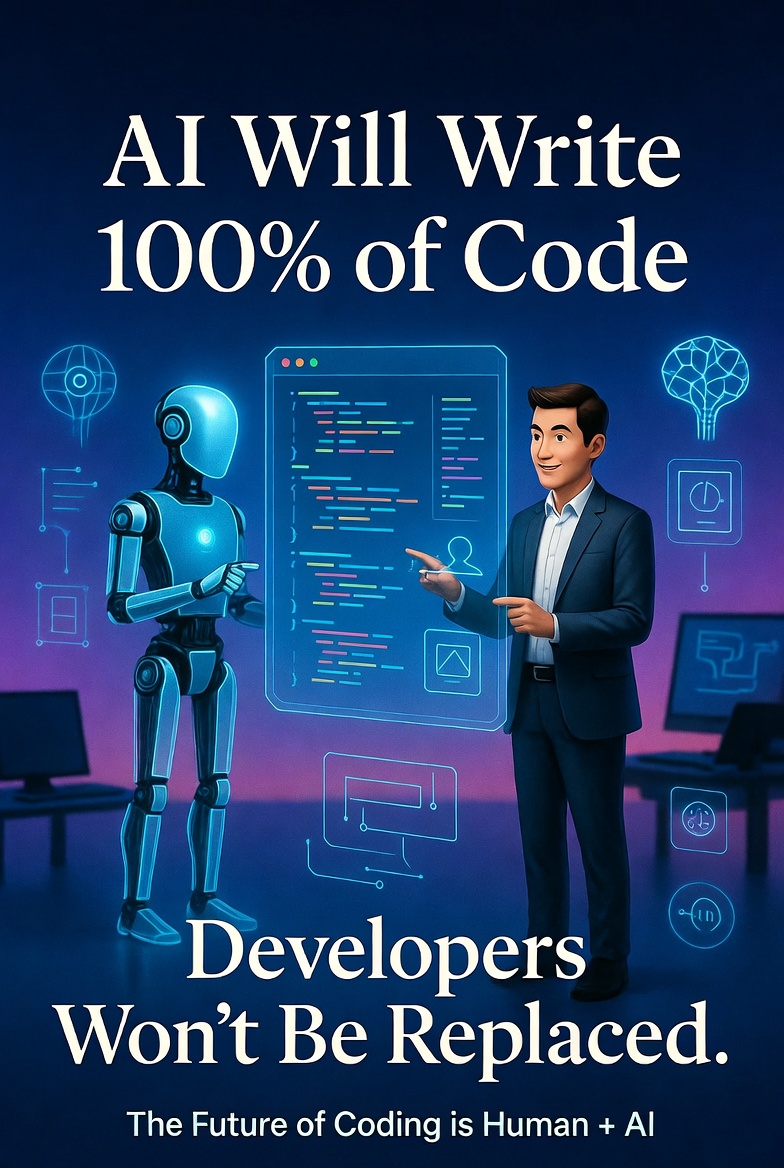
AI Will Write 100% of Code.
Developers Won’t Be Replaced — They’ll Become Security Auditors.
The headline that got 40k views in 3 hours: “In the next 6 months, AI will write 100% of the code and developers will be replaced.”
It’s provocative. It’s viral. It’s also wrong — but not for the reasons most people think.
I’ve spent 10 years in cybersecurity and 5 years building AI agents. I audit OpenClaw deployments, test prompt injection vulnerabilities, and watch AI-generated code fail in production. Here’s what I actually see.
What’s Actually True
AI is writing more code. Much more. And the acceleration is real.
Cline, OpenClaw, Cursor — the tools are here. And they’re accelerating. If you’re building AI agents, you already know: the code generation part is getting frighteningly good.
What’s Missing from the Headline
The viral take skips three critical layers that anyone running production systems — or auditing them — understands.
1. AI Code Is Buggy — Especially on Security
I audit AI agents for a living. The code AI writes looks confident. It’s often wrong. In my audits, I consistently find:
- Prompt injection vulnerabilities in agent skills
- Hardcoded API keys in plaintext configs
- Broken authentication flows that work in demos but fail in the wild
- Logic errors that only surface under real load or malicious input
Someone has to find these before they become breaches. That someone is not the AI.
2. AI Doesn’t Understand Your Business
AI knows how to write a payment processor. It does not know:
- Your compliance requirements (SOC2, ISO27001, GDPR, HIPAA)
- Your threat model or which data is truly sensitive
- How your 10-year-old legacy system actually works
- What “acceptable risk” means for your board
Someone has to translate business context into code and guardrails. That’s still a human job.
3. AI Can’t Take Responsibility
When AI-generated code causes a breach, who gets the call? Not the AI. Not Anthropic. Not OpenAI.
The CTO. The security lead. The developer who approved it. Accountability stays human. And until that changes, the humans in the loop aren’t going anywhere.
What Actually Happens Next
The market won’t need fewer developers. It will need developers who can review, secure, and architect AI-generated systems. That’s a different skillset, not an eliminated one.
Why This Matters for Your Business
If you’re building AI agents — OpenClaw, custom skills, voice agents — you’re already living in this new world.
- Who reviews the code your AI agent writes?
- Who audits the skills your agent loads?
- Who validates that API keys aren’t exposed in configs?
- Who tests for prompt injection before deployment?
If your answer is “the AI,” you’re the client I work with after something breaks. I’ve seen it happen — Twilio bills racked up, customer data leaked, reputations damaged in a weekend.
The Real Opportunity
AI agents are the fastest-moving tech since the internet. Security is moving slower. That gap is where I live.
- OpenClaw deployments need security audits
- AI-generated code needs human review
- Prompt injection needs rigorous testing
- API keys and credentials need protection
Every AI agent is a new attack surface. Someone has to lock it down. That’s not a cost center — it’s the foundation for trusting AI in production.
🦞 Need to secure your AI agents?
I audit OpenClaw deployments, test for prompt injection, and harden agent infrastructure. One weekend of testing can save you a nightmare.
🔒 View Pentest Services →My Take
AI will write 100% of the code. Yes.
Developers will be replaced. No.
They’ll become something more valuable: the humans who ensure AI-generated code is secure, correct, and aligned with business reality.
And someone needs to secure the agents that write the code.
That’s not hype. That’s my business — and yours, if you’re building for this new world.
What do you think? Drop a DM @StackOfTruths or book a free consult to talk about AI agent security.

















Leave a Reply