

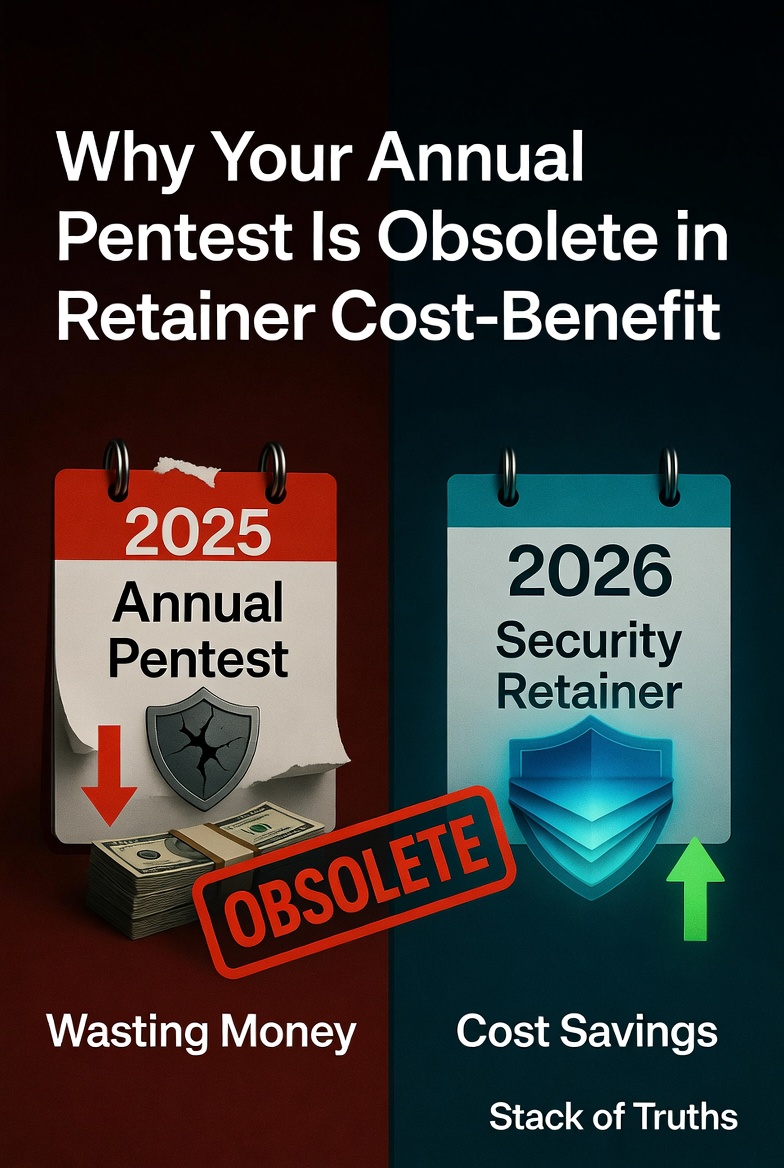
Why Your Annual Pentest Is Obsolete in 2026
Let me tell you a story.
In 2024, a fintech startup paid €8,000 for a “comprehensive” annual pentest. They passed with flying colors. No critical findings. They felt safe.
Three months later, an attacker walked through a prompt injection vulnerability that appeared after a routine AI agent update. The pentest report was still warm. The breach cost them €47,000 in stolen credits, legal fees, and customer churn.
The problem wasn’t the pentest. The problem was the assumption that security is a once-a-year event.
The 2026 Reality: Attackers Never Take a Day Off
In 2020, annual pentests made sense. Your infrastructure was relatively static. You deployed once a quarter. Attackers were mostly automated scanners looking for known CVEs.
In 2026, everything has changed:
- AI agents update weekly — new capabilities = new vulnerabilities
- Prompt injection evolves daily — last month’s test didn’t catch this month’s technique
- Attackers are using AI too — they probe continuously, not annually
- Compliance requirements are tightening — EU AI Act demands ongoing monitoring (Article 29)
The math is simple: if you test once a year, you’re unprotected for 364 days.
Let’s Do the Math: Annual Pentest vs Security Retainer
Here’s what most founders don’t realize. A “cheap” annual pentest isn’t cheap at all when you factor in the gaps.
| Service | Annual Pentest (One-Time) | Security Retainer (Annual) |
|---|---|---|
| Full pentests per year | 1 | 4 (quarterly) |
| Vulnerability scans | 0 | 12 (monthly) |
| Incident response | ❌ Not included | ✅ 24/7 included |
| Priority support | ❌ No | ✅ Yes |
| Monthly security reports | ❌ No | ✅ Yes |
| Remediation verification | ❌ No (extra cost) | ✅ Included |
| Total annual cost | €3,000 | €18,000 |
Wait — the retainer looks more expensive, right? Not so fast.
What the Annual Pentest Doesn’t Include (But You’ll Pay For)
- Re-test after fixes: €1,500 (50% of original price) — and you’ll need it
- Emergency incident response: €2,500–€5,000 per incident — average company has 1-2 per year
- Monthly vulnerability scans: €1,200/year if bought separately
- Ad-hoc consulting after breaches: €350/hour × 20 hours = €7,000
€3,000 (pentest) + €1,500 (re-test) + €3,500 (one incident response) + €1,200 (scans) = €9,200+
And you still have no coverage for the other 11 months.
Compare that to the retainer: €18,000/year for complete coverage — 4 pentests, 12 scans, incident response, priority support.
If you buy the components separately (4 Red Teams at €5k each = €20k + scans + incident response), you’re looking at over €26,000/year. The retainer saves you 30%.
But What About the EU AI Act?
If you’re deploying AI agents in the EU (or serving EU customers), the EU AI Act (Regulation 2024/1689) changes everything.
- Article 9 — Requires continuous risk management throughout the AI lifecycle
- Article 15 — Mandates ongoing cybersecurity and robustness testing
- Article 29 — Demands post-market monitoring (not a one-time assessment)
An annual pentest won’t satisfy Article 29. The regulator expects continuous monitoring. That’s exactly what a security retainer provides.
Non-compliance fines? Up to €35 million or 7% of global annual turnover. Suddenly, €18,000/year looks like a bargain.
The Hidden Costs of Annual Pentests
Beyond the money, there’s what you’re actually losing:
- Time to detection: With annual testing, the average breach takes 277 days to detect. With continuous monitoring, it’s down to 7 days.
- Customer trust: One breach announcement can destroy years of reputation building.
- Developer velocity: Without ongoing security, your team either moves fast and breaks things (literally) or slows down to a crawl second-guessing every deployment.
- Compliance anxiety: Every SOC2, ISO27001, or EU AI Act audit becomes a fire drill instead of a routine check.
What You Actually Get With a Security Retainer
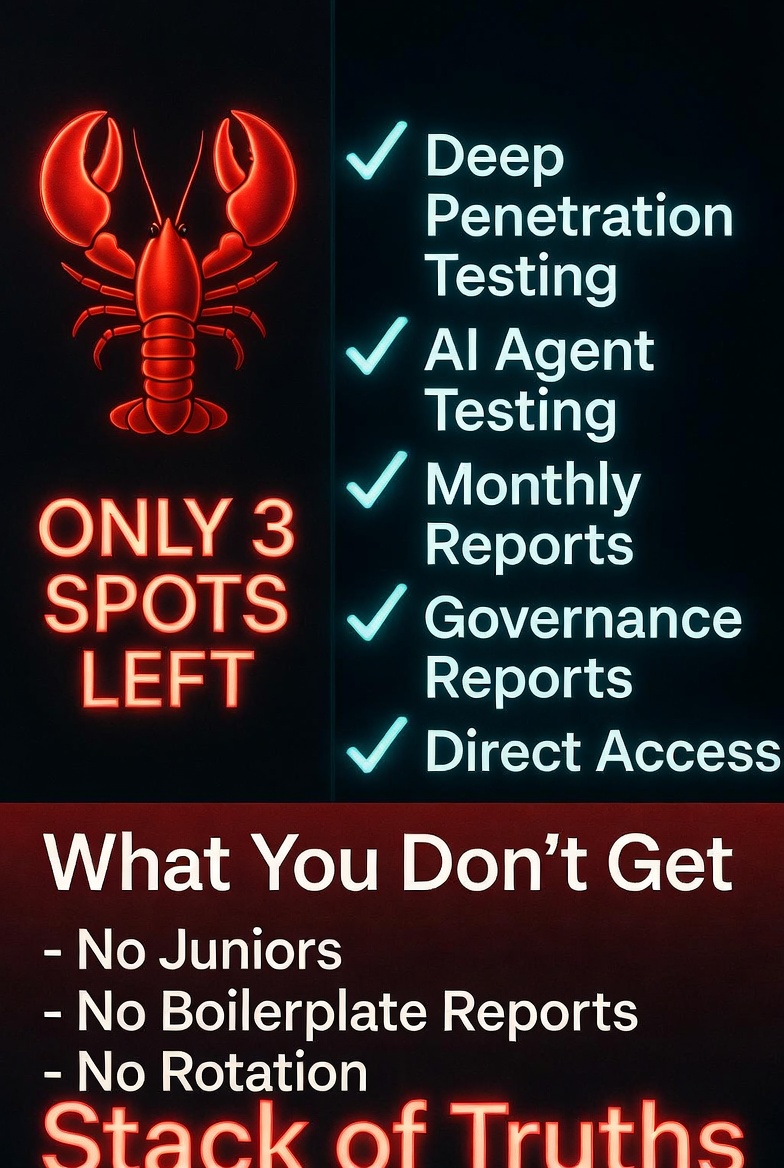
Here’s the breakdown of what €1,500/month buys you in 2026:
- Quarterly full pentests (4x/year) — Your security is tested every 90 days, not once annually
- Monthly vulnerability scans (12x/year) — We catch new vulnerabilities within days, not months
- 24/7 incident response — When something goes wrong at 2 AM on a Sunday, you have a human to call
- Priority support — No waiting in queues. You DM me, I answer within hours.
- Monthly security reports — Track your security posture over time, not just one snapshot
- Remediation verification — I test your fixes at no extra cost
- Compliance support — Use my reports for SOC2, ISO27001, EU AI Act audits
But I’m Just a Small Startup
I hear this a lot. And here’s my honest answer:
Attackers don’t care about your size. They care about your access. If you have API keys, customer data, or spending power — you’re a target.
In 2025, 43% of cyberattacks targeted small businesses. Only 14% were prepared. The average cost for a small business? €87,000.
Can you afford that? Or can you afford €1,500/month?
I designed the retainer for founders like you. Enterprise-grade security at startup prices. No sales team markups. No bloated contracts. Just me, doing the work personally.
The Catch — And Why Only 3 Spots
I only take 8 retainer clients at a time. Right now, 5 are taken, 3 are available.
Why the limit? Because I do every test personally. No outsourcing. No junior pentesters learning on your dime. You get me — 10 years cyber, 5 years AI, 22 certifications — on every engagement.
When the 8 spots are full, you join the waitlist. Current clients stay locked in. New clients wait.
When these are gone, next available spot is estimated 4-6 weeks out. Don’t wait until after a breach to wish you had continuous coverage.
The Bottom Line
Annual pentests were fine for 2020. It’s 2026. Attackers use AI now. Your infrastructure changes weekly. Compliance demands continuous monitoring.
The math is simple:
- Annual pentest: €3,000 + uncovered risk + breach potential + compliance anxiety
- Security retainer: €18,000/year → 4 pentests, 12 scans, incident response, peace of mind, compliance ready
The question isn’t “Can I afford a retainer?” It’s “Can I afford not to have one?”
Because the breach will cost you more. And it’s not a matter of if. It’s when.
🦞 Ready for continuous security?
Only 3 retainer spots left. DM me first. Quick chat. Then we book a call if we’re a fit.
No Calendly. No robots. Just a human who breaks AI agents for a living.


















Leave a Reply