

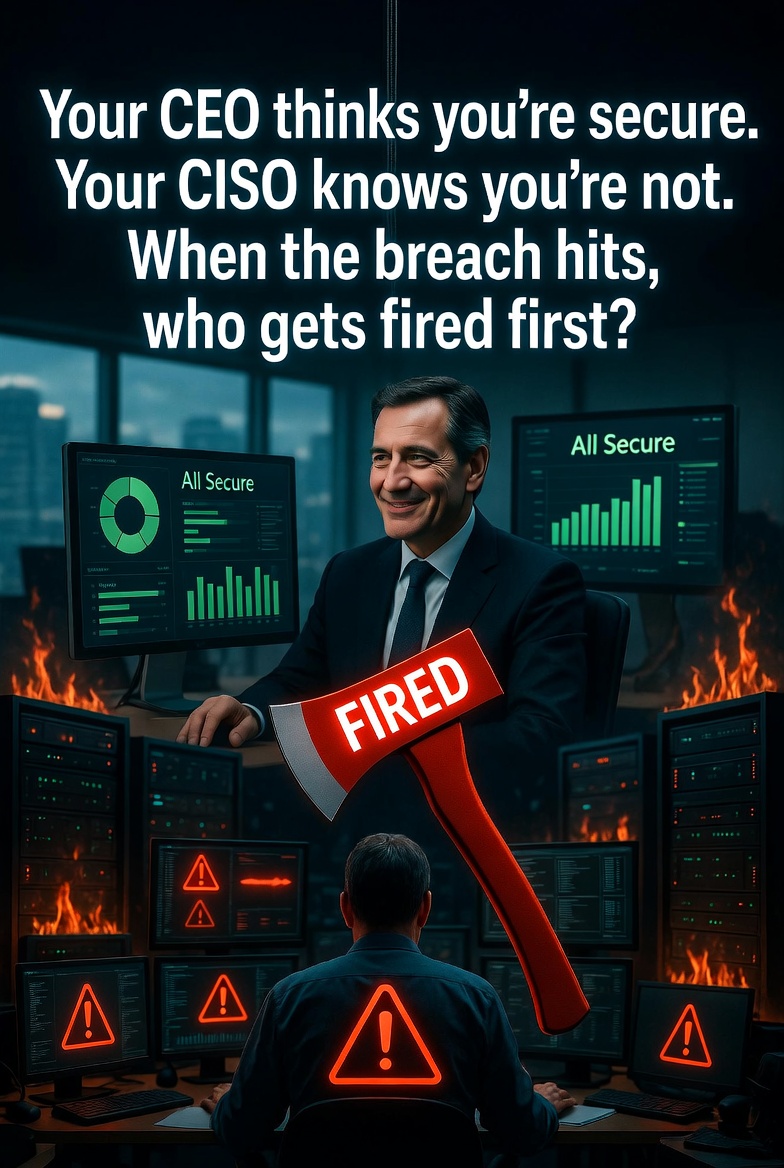
Your CEO thinks you’re secure. Your CISO knows you’re not. When the breach hits, who gets fired first?
Every morning, your CEO walks into the office and believes the company is secure. Compliance checkmarks are green. The last audit passed. The board hasn’t asked any hard questions.
Every morning, your CISO walks into the office and sees the gaps. The unpatched servers. The shadow IT. The false positives everyone ignores. The budget requests that got denied. The vulnerabilities they’ve been begging to fix for six months.
Then the breach hits.
And we all know who gets fired first.
The Gap Between Perception and Reality
Let me paint you a picture of most companies today:
- CEO’s view: “We passed our compliance audit. We have a CISO. We’re secure.”
- CISO’s view: “We passed because the auditor didn’t look hard enough. We have 147 critical vulnerabilities. I’ve been asking for a budget increase for 8 months. No one listens.”
This gap isn’t new. But it’s getting wider. And it’s getting more dangerous.
Attackers don’t care about your compliance audit. They care about your actual security posture. And your actual security posture is what your CISO sees — not what your CEO believes.
Why CISOs Are Set Up to Fail
It’s not because they’re bad at their jobs. It’s because the system is broken.
1. They inherit insecure environments
Most CISOs walk into organizations that have been accumulating technical debt for years. Legacy systems. Spaghetti architecture. No documentation. The previous CISO was fired (or quit). They’re expected to fix everything with no transition and half the budget they need.
2. They fight for budget every year — and lose
“Security is a cost center.” How many times have you heard that? CISOs fight for every dollar. They build business cases. They show breach costs. They compare to industry benchmarks. And still, they get 60% of what they asked for. Because the breach hasn’t happened yet. So why spend the money?
3. They’re ignored until something breaks
No one thinks about security when everything is working. The CISO sends reports. No one reads them. They raise concerns. No one acts. Then a breach happens. And suddenly everyone wants to know why the CISO didn’t stop it.
4. They’re the designated fall guy
When a breach happens, someone has to take the blame. It won’t be the CEO who denied the budget. It won’t be the board who prioritized features over security. It won’t be the engineering team who shipped vulnerable code. It will be the CISO. That’s the job. Be the shield. Then be the scapegoat.
The Board Conversation No One Has (Until It’s Too Late)
Here’s what happens in most boardrooms:
- Before breach: “Security is important. But we have budget constraints. Let’s focus on growth.”
- During breach: “How did this happen? Why weren’t we prepared? Who’s responsible?”
- After breach: “We need to make changes. Starting with security leadership.”
The CISO gets fired. A new CISO gets hired. The cycle repeats.
The underlying problems — underfunding, ignored warnings, technical debt — never get fixed. They just get inherited by the next person.
What CEOs Need to Hear (Before the Breach)
If you’re a CEO reading this, here’s what your CISO wants to tell you but can’t:
- “I need more budget. Not because I like spending money. Because the attackers aren’t getting cheaper.”
- “That report I send you every month? Please read it. Or at least ask me one question about it.”
- “When I say we have a critical vulnerability, I’m not being dramatic. I’m telling you we’re about to get breached.”
- “If you fire me after a breach, the next CISO will have the same problems. The only thing that changes is my face.”
- “I’m not the enemy. The attackers are. But I can’t stop them alone.”
The breach isn’t inevitable. But it’s likely. And when it happens, the question won’t be “did the CISO warn us?” It’ll be “why didn’t we listen?”
The only way to break the cycle is external validation. A pentest. A third-party audit. Something your CEO can’t ignore because it comes from outside the building.
What CISOs Can Do (When No One Is Listening)
If you’re a CISO reading this, you already know the drill. But here’s practical advice:
- Document everything. Every warning. Every request. Every denial. When the breach happens, you’ll need receipts.
- Get external validation. Your CEO might ignore you. They might not ignore a pentest report from an independent third party. Use it as leverage.
- Speak in business terms. Don’t say “we have a critical vulnerability.” Say “if we don’t fix this, there’s a 40% chance we get breached this year, costing us $4M.” Speak their language.
- Build allies. The legal team cares about liability. The finance team cares about cost. The board cares about reputation. Find their angle.
- Know when to leave. If leadership refuses to listen, refuses to fund security, and refuses to take responsibility — leave before the breach happens. Your reputation is worth more than a losing battle.
The External Validation Solution
CEOs trust external experts more than internal ones. It’s not fair. But it’s true.
That’s where I come in. A penetration test from an independent third party. No internal politics. No budget fights. Just cold, hard findings.
“We hired a pentester. They found 12 critical vulnerabilities. Here’s the report. Here’s what it will cost if we don’t fix them. Here’s what we need to do.”
That’s harder for a CEO to ignore than another internal email.
A pentest won’t fix everything. But it will tell you the truth. And the truth is the only thing that wakes people up.
What to Do This Week
- If you’re a CEO: Schedule a private conversation with your CISO. Ask them: “What’s the one thing you need that you’re not getting?” Then give it to them.
- If you’re a CISO: Get external validation. A pentest. A third-party audit. Something your CEO can’t explain away.
- If you’re on the board: Ask your CISO for a breach risk assessment. Ask for the cost of inaction. Ask for the plan.
- If you’re neither: Share this post with your CEO or CISO. Someone needs to start the conversation.
The Bottom Line
The gap between what your CEO believes and what your CISO knows is the most dangerous vulnerability in your company. Not the unpatched server. Not the misconfigured firewall. Not the weak password.
The gap is communication. Trust. Funding. Attention.
And it’s the hardest thing to fix.
But it’s not impossible. Start with a conversation. Then get external validation. Then act on the findings.
Because when the breach hits — and it might — the question won’t be “who gets fired first?” It’ll be “why didn’t we listen?”
Don’t let that be your boardroom conversation.
🦞 Need external validation your CEO can’t ignore?
I provide independent penetration testing. No internal politics. Just findings. DM me first. Quick chat. Then we book a call if we’re a fit.
No Calendly. Just a human who finds what’s broken. Based in The Netherlands 🇳🇱





















Leave a Reply