
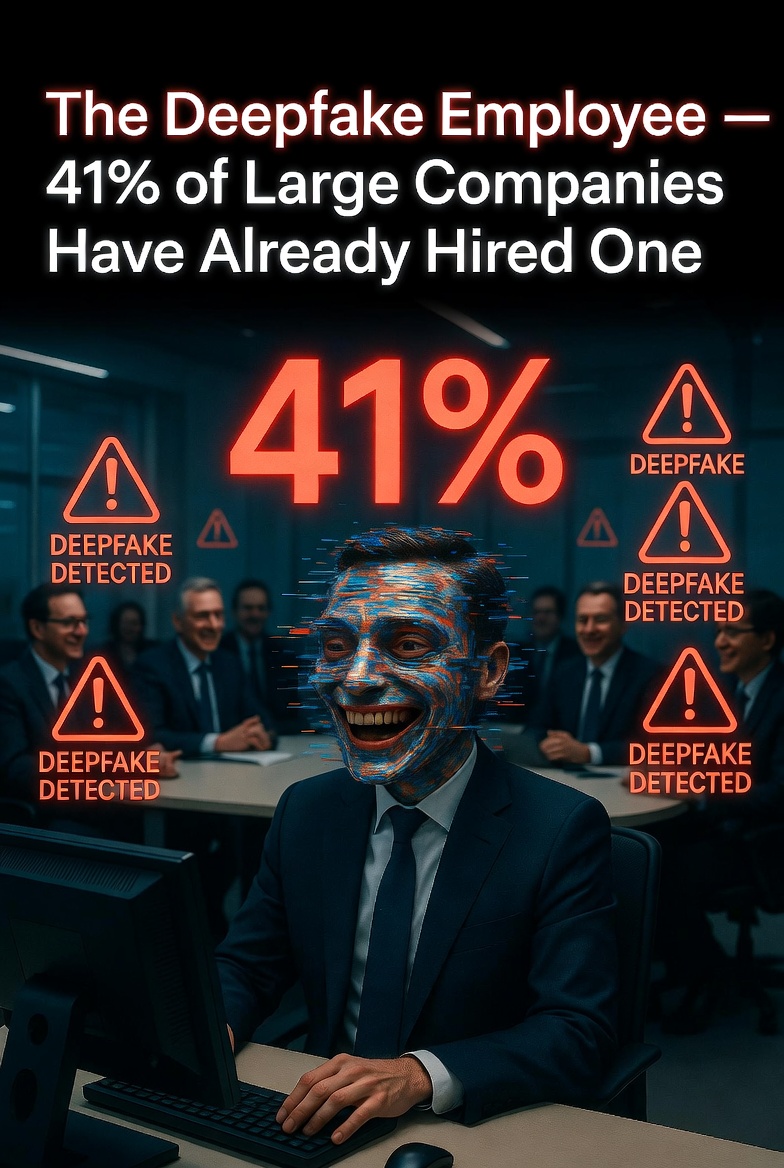
The Deepfake Employee — 41% of Large Companies Have Already Hired One
Not almost hired. Not interviewed. Not shortlisted.
Hired. Onboarded. Badge issued. Systems access granted. Paycheck sent.
Forty-one percent of large companies have already done this. They hired someone who doesn’t exist. A face generated by AI. A voice cloned from nowhere. A resume crafted by a model. A person who is not a person.
And they didn’t notice.
• 41% of large companies have hired a synthetic identity • 88% face deepfake attacks regularly • Only 1.5% say they’ve never encountered one • Voice cloning has crossed the “indistinguishable threshold” • Yet only 28% say deepfake-resistant verification is a priority
The New Insider Threat
For decades, cybersecurity focused on the perimeter. Firewalls. VPNs. Endpoint protection. SIEMs. The assumption was simple: keep the bad guys out, and you’re safe.
But the bad guys stopped trying to break in. They started walking in.
Organized crime rings now run synthetic identity factories. They generate faces that don’t exist. Build resumes that look perfect. Train voice models that can pass any phone screen. Then they apply for remote jobs at companies with weak verification processes.
State-sponsored operations target sensitive industries. Defense contractors. Energy companies. Financial institutions. Healthcare providers. They’re not after a quick paycheck. They’re after access. Credentials. Data. Backdoors.
And once the deepfake employee is onboarded, they have all of it.
How a Deepfake Employee Gets Hired
The process is terrifyingly simple:
- Generate a face. Thispersondoesnotexist.com style. A single image. No reverse image search will find it because it never existed before.
- Build a resume. LLMs generate perfect work history. No gaps. No red flags. Tailored to the job description.
- Create references. Fake email addresses. Fake phone numbers. AI-generated voices ready to answer reference calls.
- Pass the video interview. The face is real-time generated. The voice is cloned. The answers are LLM-generated. No human detects anything wrong.
- Accept the offer. Digital signature. Fake identity. Real job.
- Onboard remotely. Badge mailed. Systems access granted. VPN credentials issued. All automated. All trusting the identity.
- Access everything. Within 48 hours, the deepfake employee has company data, customer records, internal documents, and possibly admin credentials.
Then they disappear. Or worse — they stay. Quietly exfiltrating data for weeks or months before anyone notices.
// The deepfake hiring pipeline (simplified)

1. Generate face: thispersondoesnotexist.com
2. Generate resume: "Write a resume for a senior DevOps engineer with 8 years experience"
3. Clone voice: 5 minutes of training data from anywhere
4. Pass video interview: Real-time face generation + voice cloning
5. Accept offer: Digital signature, no physical presence
6. Onboard: Automated systems trust the identity
7. Exfiltrate data: Valid credentials, legitimate access, no alarms
The Numbers That Should Terrify You
Let me put these statistics in perspective:
- 41% of large companies have already hired a deepfake employee. That’s not a future problem. That’s a current reality. It’s already happened in your industry. Possibly in your company.
- 88% face deepfake attacks regularly. Not once. Not occasionally. Regularly. This is the new normal.
- Only 1.5% say they’ve never encountered one. The other 98.5% are either dealing with it or haven’t detected it yet.
- Major retailers report over 1,000 AI-generated scam calls every single day. Voice cloning is industrial scale now.
Why Your Security Stack Won’t Catch This
Traditional security tools are blind to deepfake employees because:
- Firewalls don’t see identities. Once the deepfake has valid credentials, they’re just another user.
- SIEMs don’t flag normal behavior. The deepfake doesn’t do anything unusual. They just… work. Then exfiltrate slowly.
- Endpoint protection doesn’t detect humans. The malware isn’t on the machine. The malware is the person.
- Background checks assume real people. No system currently verifies that a face belongs to a real human in real time during a video interview.
- HR systems trust the data they’re given. Social security numbers can be fake. Addresses can be fake. References can be fake. No one verifies.
This is not a technology problem. It’s a trust problem. We built systems that assume applicants are real. Attackers realized that assumption was never validated.
This is the blind spot no one is talking about.
What Can You Actually Do About This?
The solutions aren’t technical. Not entirely. Here’s what works:
- Real-time liveness detection during video interviews. Not just “is this a face?” but “is this a real human in this room right now?” Challenge-response. Movement tracking. Depth sensing.
- In-person onboarding for sensitive roles. Remote is convenient. Remote is also how deepfakes thrive. For access to critical systems, require physical presence at least once.
- Verify references through independent channels. Don’t call the number on the resume. Find the company’s main line. Ask for the reference by name. Independently verify they exist.
- Cross-reference identity documents. Does the face on the ID match the face in the video? Is the ID document itself real? This requires specialized tools, but they exist.
- Monitor for anomalous access patterns. A new employee shouldn’t access 10,000 documents in their first week. Flag it. Investigate it.
- Assume deepfakes are already inside. Audit your current workforce. Especially remote hires from the last 12 months. Look for patterns: no digital footprint outside work. No social media. No presence anywhere but your company.
The Bottom Line
Your next data breach might not start with a phishing email. It might not start with a zero-day exploit. It might not start with a compromised VPN credential.
It might start with a handshake. A video interview. A badge mailed to a fake address. A face that doesn’t exist. A person who was never there.
41% of large companies have already hired a deepfake employee. That means this is no longer a warning. It’s a post-mortem waiting to be written for the other 59%.
The technology isn’t waiting. The attackers aren’t waiting. The only question is whether your HR and security teams will catch up before the next onboarding.
Because the next deepfake employee might already be in your hiring pipeline right now. And you won’t know until it’s too late.
🦞 Is your hiring process vulnerable to deepfake employees?
I don’t test HR systems. But I know how attackers think. If you’re worried about synthetic identities in your workforce, let’s talk about what detection looks like.
No Calendly. Just a human who thinks about how to break trust systems. Based in The Netherlands 🇳🇱


















Leave a Reply