

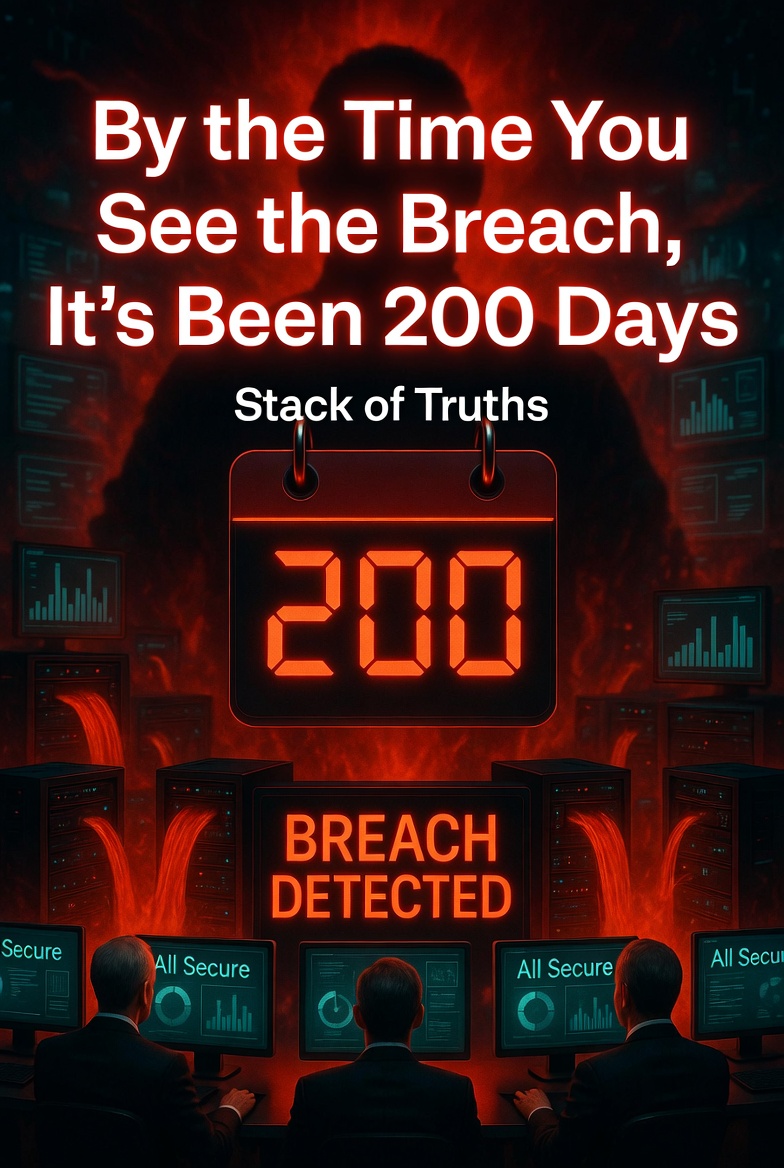
By the Time You See the Breach, It’s Been 200 Days
May 18, 2026 — 6 min read — Pedro Jose
Average dwell time: 200 days.
That’s how long attackers sit inside your systems before you notice.
Not because they’re stealthy. Because you’re not looking in the right places.
⚡ 200 DAYS.
That’s enough time to:
• Map your entire network
• Steal every customer record
• Backdoor your supply chain
• Test your incident response team (they fail)
• Sell your data on the dark web
• Watch your stock price drop
That’s enough time to:
• Map your entire network
• Steal every customer record
• Backdoor your supply chain
• Test your incident response team (they fail)
• Sell your data on the dark web
• Watch your stock price drop
Meanwhile, your SIEM is quiet. Your EDR sees nothing. Your annual pentest report sits in a drawer.
Why Dwell Time Keeps Getting Worse
| Reason | Reality |
|---|---|
| Tool overload | 47 security tools. Zero correlation. |
| Alert fatigue | 10,000 alerts/day. 4 investigated. |
| Log retention | 30 days. Attackers know this. |
| Pentest frequency | Once a year. Attackers test daily. |
| AI agents | New attack surface. No monitoring. |
The 200-Day Breakdown
| Phase | Duration | What Happens |
|---|---|---|
| Initial access | 1 day | Phish, stolen creds, misconfig |
| Reconnaissance | 30 days | Mapping your infrastructure |
| Lateral movement | 60 days | Moving quietly, testing privileges |
| Data staging | 50 days | Finding what’s valuable |
| Exfiltration | 1 day | Everything leaves |
| Ransom + extortion | 59 days | Negotiation, leaks, press |
📌 By the time you get the alert, they’ve already won.
The Math You Don’t Want to Do
- Average breach cost: $4.45M
- Dwell time reduction from 200 to 20 days: saves ~$1.2M
- Cost of continuous testing: $1,500/month = $18,000/year
You’re paying for detection. They’re paying for patience.
One of these strategies works.
Why Traditional Testing Fails
- Annual pentests — snapshot of a single moment. Attackers work in real-time.
- Automated scans — find low-hanging fruit. Miss exploit chains.
- SIEM alerts — volume kills signal. Attackers hide in the noise.
- Red team once a year — great for compliance. Useless for continuous threat exposure.
What Actually Reduces Dwell Time
| Tactic | Impact |
|---|---|
| Continuous automated scanning | Find new vulnerabilities weekly |
| Quarterly pentests | Catch what scanners miss |
| 24/7 log monitoring | Spot anomalies early |
| Attack surface management | Know what you expose |
| Human-led threat hunting | Find what tools ignore |
The 200-Day Reality Check
Ask yourself:
- When was your last real breach test? (Not a scan. A real test.)
- How long would it take you to notice a data exfiltration?
- Do you monitor outbound traffic for large transfers?
- When did you last review your SIEM rules?
- Are your logs stored for more than 30 days?
🧠 If you can’t answer these in 10 seconds, attackers already know your gaps.
Your Competitors Are Already Shortening Dwell Time
Not because they have bigger budgets. Because they stopped assuming.
They test continuously. They monitor actively. They hunt daily.
And when a breach happens — not if — they find it in days, not months.
📌 THE BOTTOM LINE
200 days is the average.
Some companies find breaches in 20 days. Some in 2 days.
Where do you want to be?
200 days is the average.
Some companies find breaches in 20 days. Some in 2 days.
Where do you want to be?
🦞🔐
Stop discovering breaches. Start detecting them.
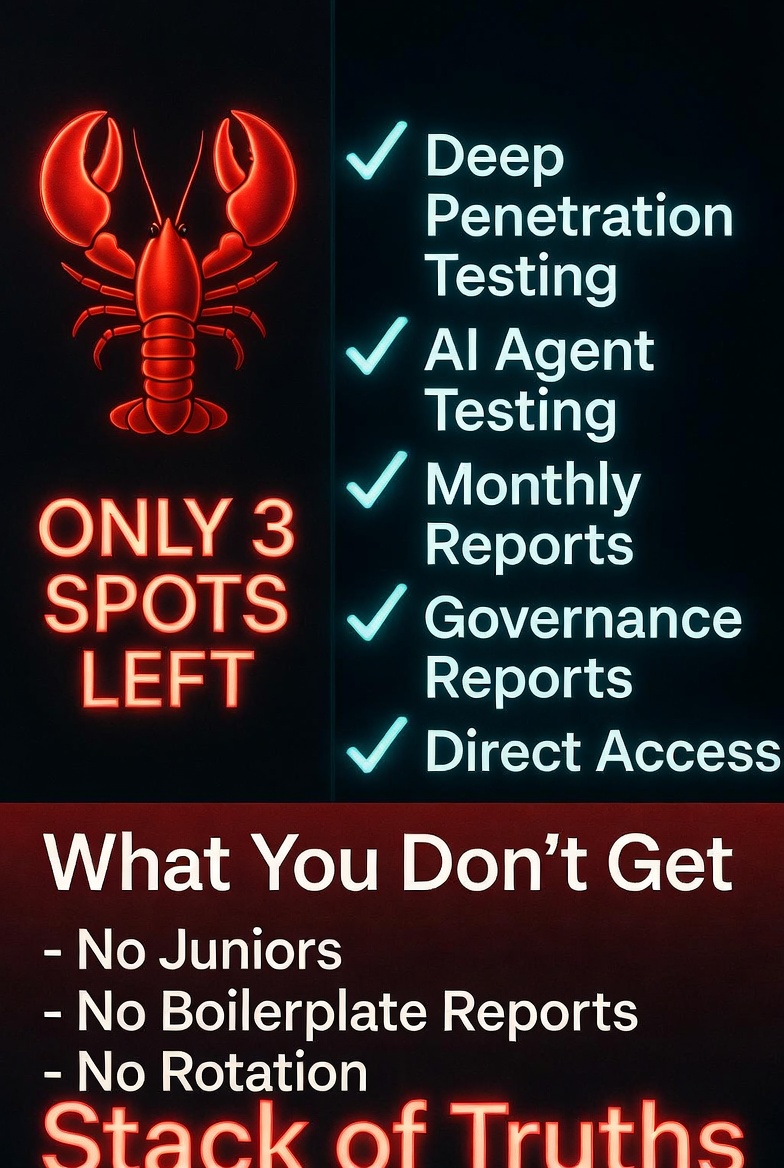
Continuous testing. Quarterly pentests. 24/7 support. Security retainer: €1,500/month.
📩 DM @StackOfTruths on XFree 15-min consultation. No hard sell. Just honest answers.



















Leave a Reply