
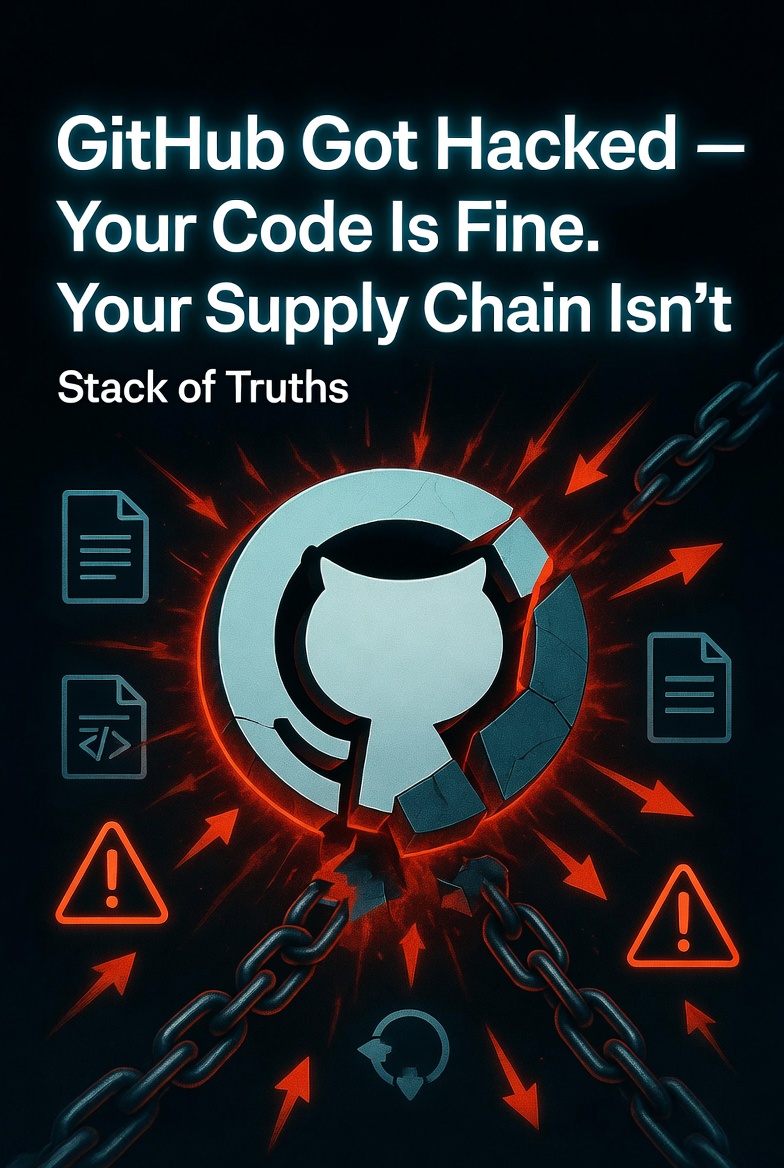
GitHub Got Hacked — Your Code Is Fine. Your Supply Chain Isn’t.
May 20, 2026, 07:48 UTC. GitHub posted a terse update: “We are investigating unauthorized access to GitHub’s internal repositories.”
No details. No root cause. No “we fixed it.” Just a notification that someone was inside their internal code.
GitHub says customer data is safe. That’s not the point. The point is: the attacker had access to GitHub’s internal source code, CI/CD pipelines, and signing keys. That’s the supply chain nightmare every security professional loses sleep over.
GitHub is the central bank of modern software development. 100+ million developers. 400+ million repositories. If an attacker plants a backdoor in GitHub’s internal build system, every piece of software built on that infrastructure becomes compromised. Not “if.” When.
What We Know (And Don’t Know)
GitHub’s internal repositories — the source code for GitHub itself — were accessed by an unauthorized party. This is not a customer repo breach. This is the source of the source control platform.
GitHub states no evidence of impact to customer enterprises, organizations, or repositories. But internal repository access often leads to source code theft, credential harvesting, and pipeline manipulation.
The attacker didn’t need to touch your repo. If they compromised GitHub’s CI/CD signing keys or release pipelines, they could inject malicious code into future GitHub Actions, CLI tools, or even the GitHub platform itself.
SolarWinds was breached. Attackers inserted a backdoor into Orion updates. 18,000 customers installed it themselves.
GitHub is orders of magnitude larger. If attackers compromised GitHub’s build pipeline, the blast radius makes SolarWinds look like a parking ticket.
The Attack Surface GitHub Just Opened
- Source code theft — GitHub’s internal security mechanisms, now in attacker hands.
- Action poisoning — Popular GitHub Actions could be backdoored at the source.
- Signing key compromise — Attacker could sign malicious releases as “official GitHub software.”
- Credential harvesting — Internal tokens, API keys, and certificates now potentially exposed.
- Pipeline manipulation — The build system itself could be altered to inject payloads into all downstream artifacts.
GitHub’s internal repositories contain the crown jewels of software distribution. Their build pipelines sign artifacts that the entire internet trusts. If that trust is broken, every developer, every CI/CD pipeline, every production server that pulls from GitHub becomes a potential target.
This is not a “change your password” incident. This is a “rebuild your entire trust chain” incident.
What You Need To Do Right Now
1. Rotate Every GitHub Token and SSH Key
Assume internal secrets were exposed. Even if GitHub says customer data is safe, internal repos often contain test credentials, deployment keys, and integration tokens.
2. Audit Your GitHub Actions Logs
Look for suspicious activity in the last 30 days. Attacker may have used stolen tokens to modify your workflows.
3. Pin Your Dependencies (Immutable Builds)
Don’t trust `@latest` tags. Use SHA‑256 hashes for any action you depend on.
4. Enable GitHub’s Security Features (If You Haven’t Already)
- Secret scanning — detects exposed tokens
- Dependency review — checks for malicious packages
- CodeQL — static analysis for vulnerabilities
- Require signed commits — ensures commit integrity
5. Prepare for a Vendor‑Led Response
Microsoft (GitHub’s owner) will likely release incident report, certificate rotations, and re‑signing of artifacts. Do not ignore those updates. Treat them as you would a CVE in your own stack.
✓ Inventory of all GitHub‑connected tools (Actions, OAuth apps, PATs)
✓ Review of CI/CD pipeline security (no plaintext secrets, no overly permissive tokens)
✓ Simulation of a backdoored Action (what happens if an attacker controls a dependency?)
✓ Third‑party artifact verification (do you trust your upstream?)
You’re not auditing your code. You’re auditing your trust in the code you depend on.
The Bottom Line
GitHub holds the keys to the kingdom. If attackers have those keys, they can unlock every door. The statement that “customer data is safe” is comforting, but irrelevant. The real question is: what can the attacker do with GitHub’s internal source code and signing keys?
Software supply chain attacks are not hypothetical. SolarWinds proved that. Codecov proved that. Now, GitHub itself is in the crosshairs.
Your CI/CD pipeline trusts GitHub implicitly. That trust may have just been violated. Audit your tokens. Pin your dependencies. And start treating GitHub as a potential attack vector — not a trusted authority.
Your supply chain is only as strong as GitHub’s security.
Full supply chain audit: €3,000. CI/CD security review: included in retainer. AI Red Team: €5,000.
📩 DM @StackOfTruths on XFree 15-min consultation. No hard sell. Just honest answers about your supply chain exposure.



















Leave a Reply