

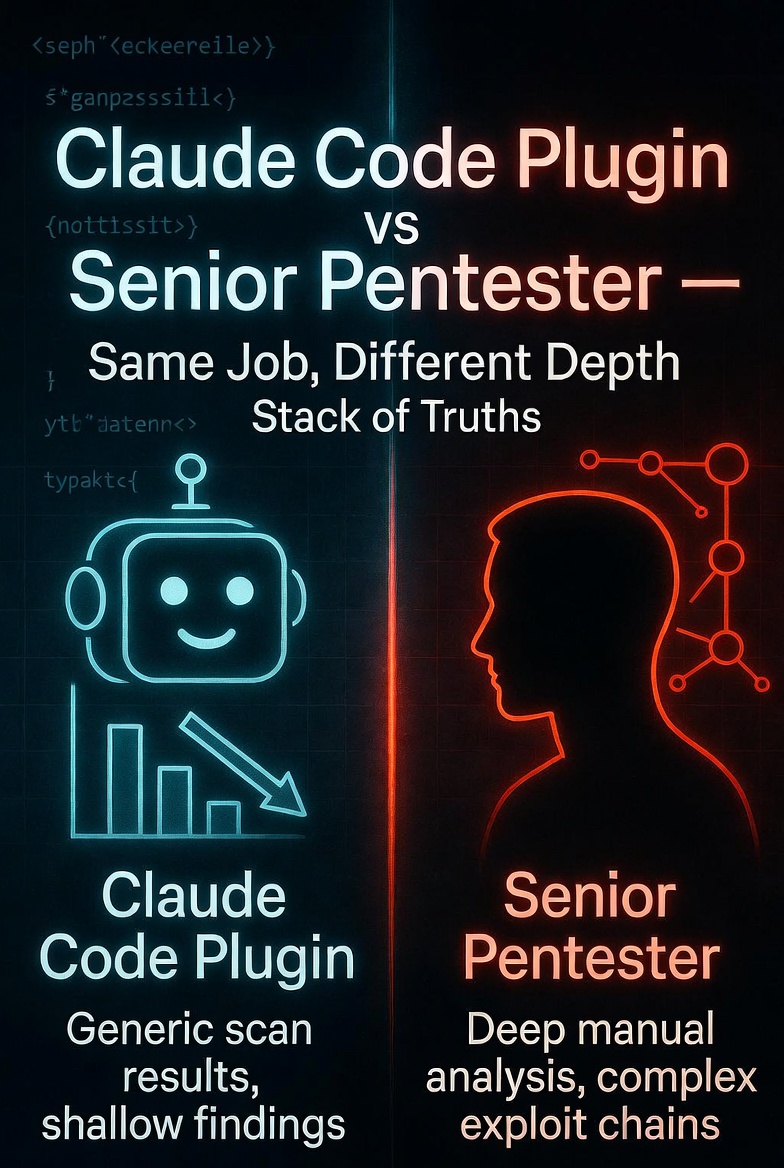
Claude Code’s New Plugin vs a Senior Pentester: Same Job, Different Depth
May 27, 2026 — 6 min read — Pedro Jose
Claude Code just dropped a security plugin. Run it. It spits out a list of findings in 5 minutes. High fives all around.
A senior pentester takes a week. They don’t just find the low‑hanging fruit. They find the chains. The business logic flaws. The “you’d never think to look there” vulnerabilities.
One is a metal detector at the beach. The other is the guy with a shovel who knows where the treasure is buried.
⚡ THE HARD TRUTH
AI scanners are great for finding the obvious. They’re terrible at finding what’s not in the pattern library. Attackers don’t exploit patterns. They exploit creativity. That’s still a human skill.
AI scanners are great for finding the obvious. They’re terrible at finding what’s not in the pattern library. Attackers don’t exploit patterns. They exploit creativity. That’s still a human skill.
Side‑by‑Side — Claude Code Plugin vs. Senior Pentester
| Capability | Claude Code Plugin | Senior Pentester (Me) |
|---|---|---|
| Time to complete | 5–10 minutes | 3–5 days (plus context gathering) |
| Low‑hanging fruit (XSS, SQLi, open ports) | ✅ Fast | ✅ Finds them too (but doesn’t stop there) |
| Business logic flaws | ❌ Almost never | ✅ Yes — this is where real breaches happen |
| Exploit chaining (three “lows” = one critical) | ❌ Cannot connect dots | ✅ Finds chains scanners miss |
| Context‑aware testing | ❌ Scans what it sees, not what it means | ✅ Knows your business, your risk, your blind spots |
| Authentication & privilege escalation | ❌ Basic checks | ✅ Deep manual testing of roles, sessions, tokens |
| False positive rate | 🔴 High (70%+ noise) | ✅ Low — every finding is real and actionable |
| Report | List of potential issues | Prioritized, evidence‑backed, with fix guidance |
📌 REAL EXAMPLE
The plugin found a missing security header. It flagged it as “medium.” A senior pentester found that missing header + a misconfigured CORS policy + a leaked internal API endpoint = account takeover for any user.
The plugin gave you a checklist. The human gave you a breach simulation. Same codebase. Different depth.
The plugin found a missing security header. It flagged it as “medium.” A senior pentester found that missing header + a misconfigured CORS policy + a leaked internal API endpoint = account takeover for any user.
The plugin gave you a checklist. The human gave you a breach simulation. Same codebase. Different depth.
What the Plugin Finds (And Why It’s Useful)
- ✅ Hardcoded secrets in code (if they’re in plaintext and the pattern is known)
- ✅ Known vulnerable dependencies (CVE database matches)
- ✅ Missing security headers (HSTS, CSP, X‑Frame‑Options)
- ✅ Basic injection patterns (SQLi, XSS — if they’re textbook examples)
- ✅ Open ports and exposed services (if they’re on standard ports)
All of this is valuable. None of it is complete. Attackers don’t stop at the first open port. Neither should your testing.
🧠 THE SCARY PART
If you run the plugin and see zero findings, you think you’re secure. You’re not. You just haven’t hired someone who knows where to look.
The plugin is a filter. The human is a digger. Don’t confuse the two.
If you run the plugin and see zero findings, you think you’re secure. You’re not. You just haven’t hired someone who knows where to look.
The plugin is a filter. The human is a digger. Don’t confuse the two.
What the Senior Pentester Finds That the Plugin Never Will
- ✅ Business logic flaws. “You can refund any transaction by changing the ID in the URL.” No scanner finds that. A human who understands your workflow does.
- ✅ Exploit chains. A misconfigured subdomain + a weak password reset + an exposed debug endpoint = full account takeover. The plugin flags each as “informational.” A human chains them into a critical.
- ✅ Logic that isn’t in the pattern library. Attackers invent new techniques. AI scanners look for known patterns. That gap is where your data gets stolen.
- ✅ Human‑centric testing. “What happens if I paste a massive JSON blob into that field?” “What if I race this request?” “What if I try a zero‑day I just thought of?” The plugin doesn’t get curious. A pentester does.
🔐 THE METAL DETECTOR ANALOGY
A metal detector finds coins on the surface. Fast. Efficient. Great for beaches.
But the real treasure is three feet down, hidden under a rock, wrapped in a story. You need a shovel, patience, and a map of where people actually lost things.
The plugin is the metal detector. I’m the guy with the shovel. Same beach. Different results.
A metal detector finds coins on the surface. Fast. Efficient. Great for beaches.
But the real treasure is three feet down, hidden under a rock, wrapped in a story. You need a shovel, patience, and a map of where people actually lost things.
The plugin is the metal detector. I’m the guy with the shovel. Same beach. Different results.
When to Use the Plugin (And When to Call a Human)
✅ Use the plugin when:
- You want a quick pre‑commit check
- You’re training junior developers to spot obvious mistakes
- You need a baseline before a real pentest (so the human doesn’t waste time on easy stuff)
✅ Call a human when:
- You’re about to launch a product that handles real customer data
- You’ve never had a full manual pentest
- You want to know what an actual attacker would do, not what a scanner thinks they might do
- You need a report you can take to your board and say “here’s what we fixed, and here’s why it matters”
⚠️ THE BOTTOM LINE
Claude Code’s plugin is a great tool. I’ll probably use it myself. But it’s a tool, not a replacement.
It finds what’s obvious. It misses what’s creative.
Attackers are creative. That’s why they still win.
You need both: the metal detector for speed, and the shovel for depth.
Claude Code’s plugin is a great tool. I’ll probably use it myself. But it’s a tool, not a replacement.
It finds what’s obvious. It misses what’s creative.
Attackers are creative. That’s why they still win.
You need both: the metal detector for speed, and the shovel for depth.
🦞🔐
The plugin scans. I dig. Same codebase. Different depth.
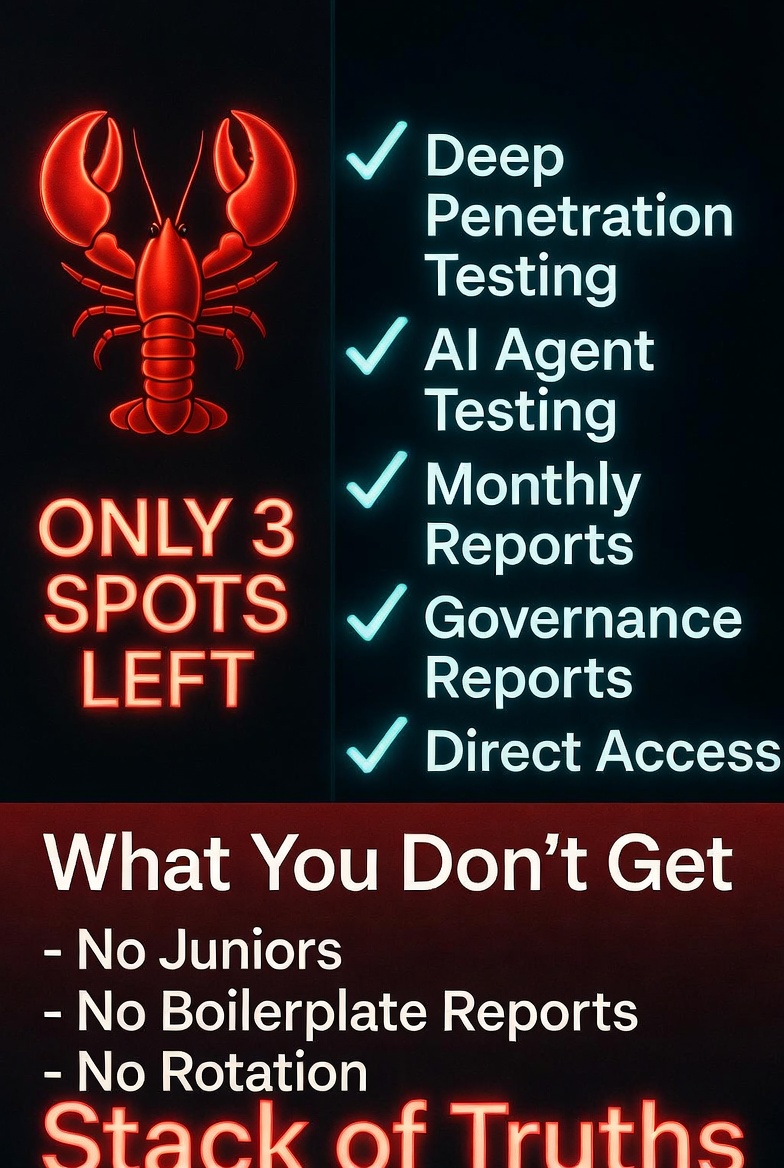
Full AI Agent Pentest: €3,000. Website pentest: €299–€1,499. Security retainer: €1,500/month.
📩 DM @StackOfTruths on XFree 15-min consultation. No hard sell. Just honest answers about what you’re really missing.



















Leave a Reply