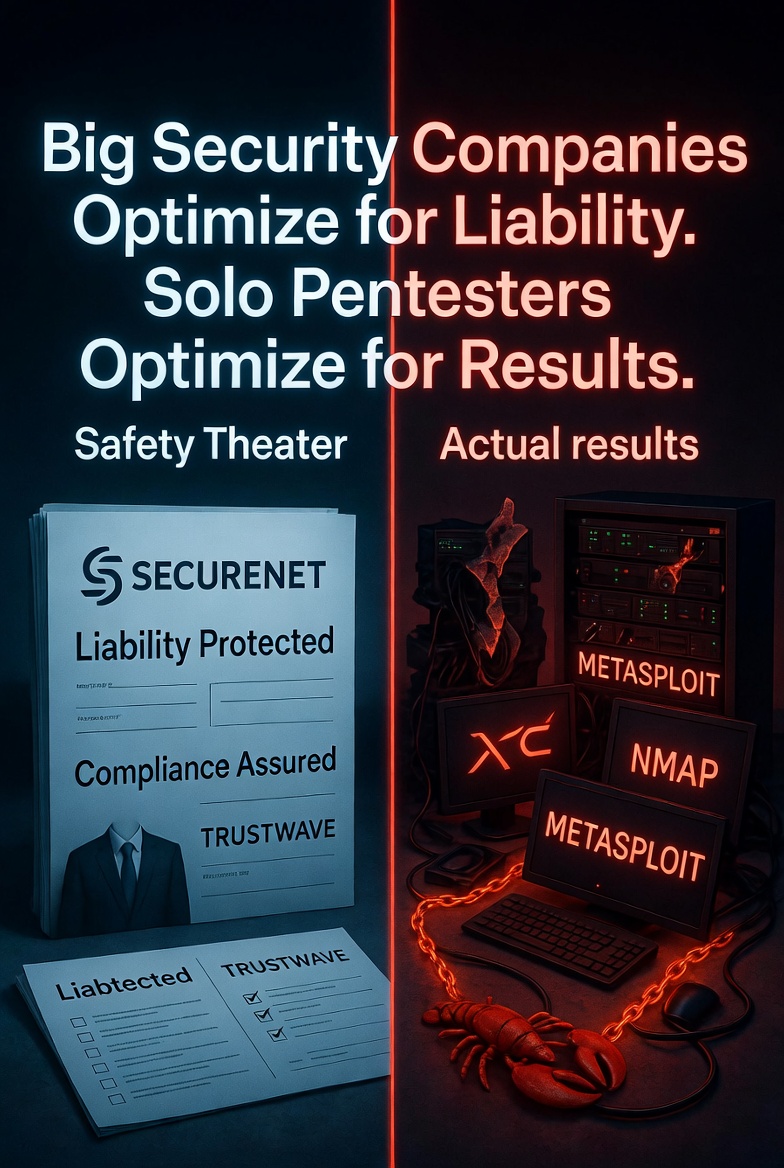
“Big security companies optimize for liability.
Solo pentesters optimize for results.
One sells you paperwork, the other sells you peace of mind.”
You hired a big-name security firm. They sent a junior analyst with a scanner and a template. You got a 200‑page PDF full of false positives, “we recommend,” and legal disclaimers.
You paid €50,000. Your security didn’t improve. Your compliance checkbox got greener. The firm’s liability got smaller.
⚡ THE HARD TRUTH
Big firms are not paid to find breaches. They are paid to not get sued. Those are different goals. One leads to real security. The other leads to thick reports and thin accountability.
The Liability Loop — How Big Firms Really Operate
Their contract is written by lawyers, not pentesters.
Every finding is filtered through “could this get us sued?”
Reports are padded with 100 pages of noise so no one can claim they missed something.
The actual test is done by a junior analyst with 18 months of scanner experience.
The partner’s name is on the report. The junior’s work is inside it.
Big firms don’t get fired for missing vulnerabilities. They get sued for saying “you’re secure.” So they never say anything conclusive. They hedge. They qualify. They recommend “best practices.”
Result: you get a report that’s legally safe for them and operationally useless for you.
📌 REAL EXAMPLE — ANONYMIZED
A €50M logistics company paid a Big Four firm €45,000 for a pentest. The report had 147 findings. 132 were false positives. The 15 real issues were buried. The developer spent three months chasing ghosts.
Six months later, a solo pentester found 8 critical vulnerabilities the big firm missed — including an exposed admin panel with default credentials and a SQLi that leaked customer data.
The big firm’s report looked impressive. It just wasn’t useful. The solo pentester’s report was 12 pages. Every finding was real. Every fix was actionable.
The Side‑by‑Side — Big Firm vs. Solo Pentester
What You Get
Big Firm (€30k–€100k+)
Solo Pentester (€3k–€10k)
Primary goal
Limit liability
Find real breaches
Who tests you
Junior analyst, maybe a senior reviewer
The person you hired. Direct.
Report length
200+ pages, 80% noise
10–20 pages, every finding real
False positive rate
🔴 High (70%+)
✅ Low
Incentive structure
Billable hours → longer is better
Results → efficient is better
After the test
“We recommend following best practices”
“Here’s the exact code change. Let me know if you need help.”
Peace of mind
❌ No — you’re still guessing
✅ Yes — you know
Why Big Firms Can’t Give You Peace of Mind
Their business model depends on repeat engagements, not on solving your problems. If they fixed everything in one test, you wouldn’t call them back.
Billable hours → The longer the test, the bigger the invoice. Efficiency is penalized.
Risk aversion → Every finding is hedged. “This might be a problem.” “We recommend considering.”
No accountability → The person who wrote the report is long gone by the time you have questions.
Template fatigue → Every report looks the same. “Missing security headers.” “TLS version outdated.” Noise. Not signal.
You’re not paying for security. You’re paying for a liability shield. The big firm protects itself. You’re just along for the ride.
🧠 THE SCARY PART
A 200‑page report gives you a false sense of security. You think you’ve been tested. You haven’t. You’ve been scanned.
Attackers don’t scan for missing headers. They chain vulnerabilities. Your big‑firm report won’t show you those chains. A solo pentester will.
What a Solo Pentester Actually Delivers
✅ Peace of mind. Not a false promise. A real assessment from someone who actually tried to break in.
✅ Real attacker mindset. Not “what does the scanner say.” But “how would I break this if I had no rules?”
✅ Chain exploitation. Finds the sequence of “low” findings that together become a breach.
✅ Business‑relevant reporting. “Fix this first. Here’s why. Here’s how.”
✅ Same‑day response. Critical finding? You get a call before the report is even written.
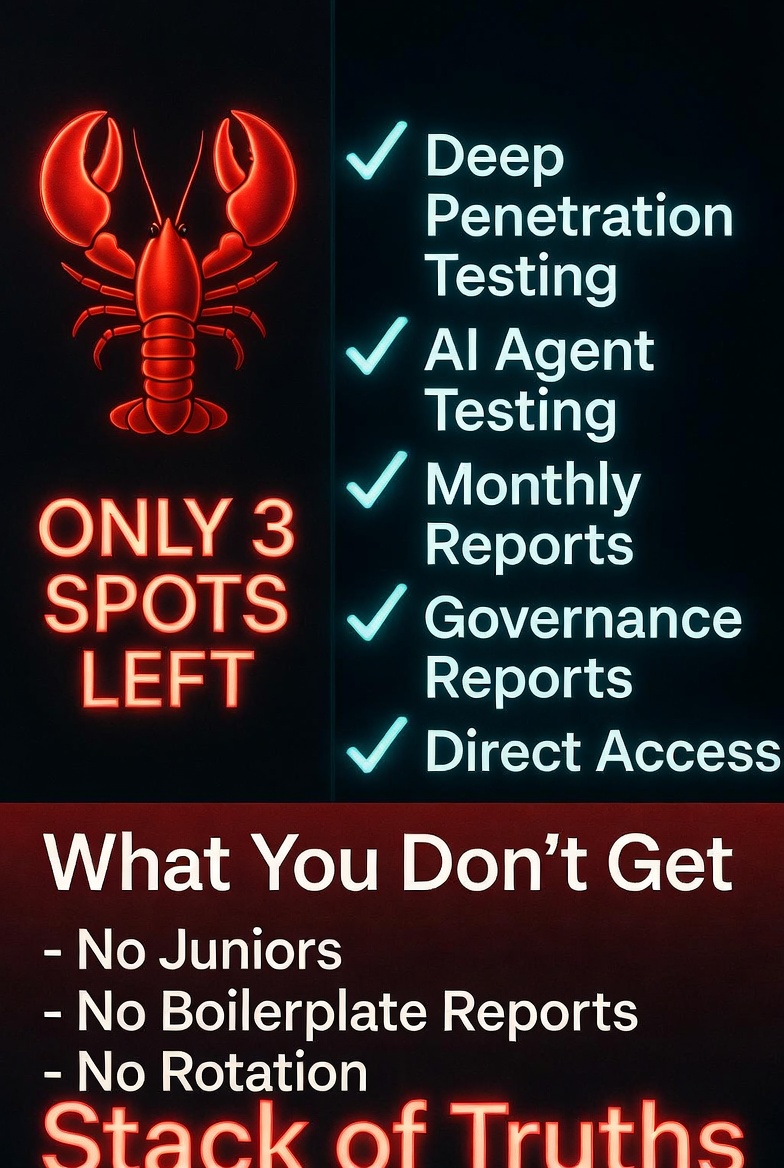
✅ No juniors. The person who scopes the test runs the test. No handoff. No loss of context.
✅ No liability hedging. I’m not worried about being sued. I’m worried about you getting breached.
🔐 THE PEACE OF MIND DIFFERENCE
Big firm: “We recommend implementing multi‑factor authentication where feasible.”
Solo pentester: “Your admin account has no MFA. Here’s the exact command to enable it. I’ll test it again tomorrow.”
One is a suggestion. The other is a fix.
When the Big Firm Actually Makes Sense
There are legitimate reasons to hire a big firm:
You need a compliance stamp that says “Deloitte/PwC/EY” on it.
Your contract requires a specific certification or insurance rider.
Your board won’t accept a solo practitioner’s signature.
If that’s you, hire the logo. Then hire a solo pentester to actually test what the big firm missed.
⚠️ THE BOTTOM LINE
Big security companies optimize for liability. Solo pentesters optimize for results.
One sells you paperwork. The other sells you peace of mind.
You’re not paying for a pentest. You’re paying for a brand — or a brain. Choose wisely.
🦞🔐
Stop paying for liability shields. Start paying for peace of mind.
Full AI Agent Pentest: €3,000. Website pentest: €299–€1,499. Security retainer: €1,500/month.
We use cookies to ensure that we give you the best experience on our website. If you continue to use this site we will assume that you are happy with it.






















Leave a Reply