


You can’t see the back of your own head. No matter how many mirrors you install, there’s always an angle you miss. Your security team is the same.
They built the infrastructure. They configured the firewalls. They wrote the access policies. They know the system inside out — which is exactly why they can’t see its flaws. Familiarity breeds blindness.
Your security team is not stupid. They’re not lazy. They’re just inside the box. Attackers are outside it. A pentester is the bridge — the person who looks at your system the way an attacker does, not the way you hope it works.
The Mirror Test — What You Don’t See
- The dev database you forgot to lock down. Your team knows it’s for testing. An attacker sees an open door.
- The default credentials you never changed. Your team says “we’ll fix it later.” An attacker says “thanks for the admin access.”
- The legacy API endpoint with no auth. Your team forgot it existed. An attacker found it in 10 minutes of scanning.
- The chain of three low-risk issues. Your team sees isolated findings. An attacker sees a path to your customer database.
A company with a dedicated security team had been running their own internal scans for years. They felt confident. Their SIEM was tuned. Their firewalls were locked down.
A pentester found a developer’s personal AWS key in a public GitHub commit from 18 months ago. The key had never been rotated. It had full access to production.
The security team didn’t know the key existed. The developer forgot they committed it. The attacker would have found it. That’s the mirror.
Why Internal Teams Can’t See the Truth
- Assumptions become facts. “We don’t expose dev databases” becomes a belief, not a verified truth.
- Alert fatigue. After 10,000 false positives, no one looks at the 10,001st alert — which might be real.
- Politics. No one wants to tell the CTO that the project they approved is a security disaster. An external pentester has no such loyalty.
- Tool blindness. Your team trusts the scanner. The scanner misses business logic flaws. The attacker doesn’t.
- Normalization of deviance. “We’ve always done it this way” becomes the standard. Even when it’s wrong.
Your security team is not the problem. The problem is that humans cannot objectively assess their own work. You need someone outside the building, outside the culture, outside the assumptions.
A pentester doesn’t care about your internal politics. They don’t care about your budget cycle. They don’t care about your developer’s feelings. They just break things.
What the Mirror Shows You
- ✅ What an attacker actually sees. Not what you hope they see. Not what your scanner says. The real view from outside.
- ✅ The gaps in your coverage. The services you forgot. The subdomains you lost track of. The cloud accounts no one monitors.
- ✅ The chains you missed. Three informational findings that together become a critical breach. Your SIEM won’t connect them. A human will.
- ✅ The truth about your security posture. Not a CVSS score. Not a compliance checkbox. A real assessment from someone who tried to break in.
A pentest isn’t an attack on your team. It’s a tool. You look in the mirror to fix your hair, not to punish the mirror.
Your security team works hard. They do good work. But they can’t see their own blind spots. That’s not a failure. That’s being human.
The pentester is the mirror. What you do with the reflection is up to you.
The Difference Between Scanning and Mirroring
An automated scanner is a foggy mirror. It gives you blurry outlines. It misses the details. It can’t understand context.
A human pentester is a clean mirror. They see the cracks in the glass. They see the reflection of the room behind you. They see what you didn’t know was there.
- Scanner: “Port 8080 is open.”
- Pentester: “Port 8080 is open, running MongoDB with default credentials, and I just dumped your customer database.”
- Scanner: “Missing security header (medium).”
- Pentester: “Missing header + misconfigured CORS + leaked internal endpoint = account takeover for any user.”
You don’t need a pentester because your team is bad. You need a pentester because your team is human.
Humans have blind spots. Attackers exploit them. A pentester finds them before the attacker does.
It’s not about trust. It’s about physics. You can’t see the back of your own head. Neither can your security team.
The Bottom Line
Every company has blind spots. That’s not a failure. That’s a fact.
Your security team builds. They configure. They monitor. They do their best. But they can’t see what they can’t see.
A pentester is the mirror. No judgment. No blame. Just a reflection of reality.
What you do with that reflection — fix the gaps, or ignore them — is your choice. But at least now you know.
Can’t see the back of your own head? Let me hold the mirror.
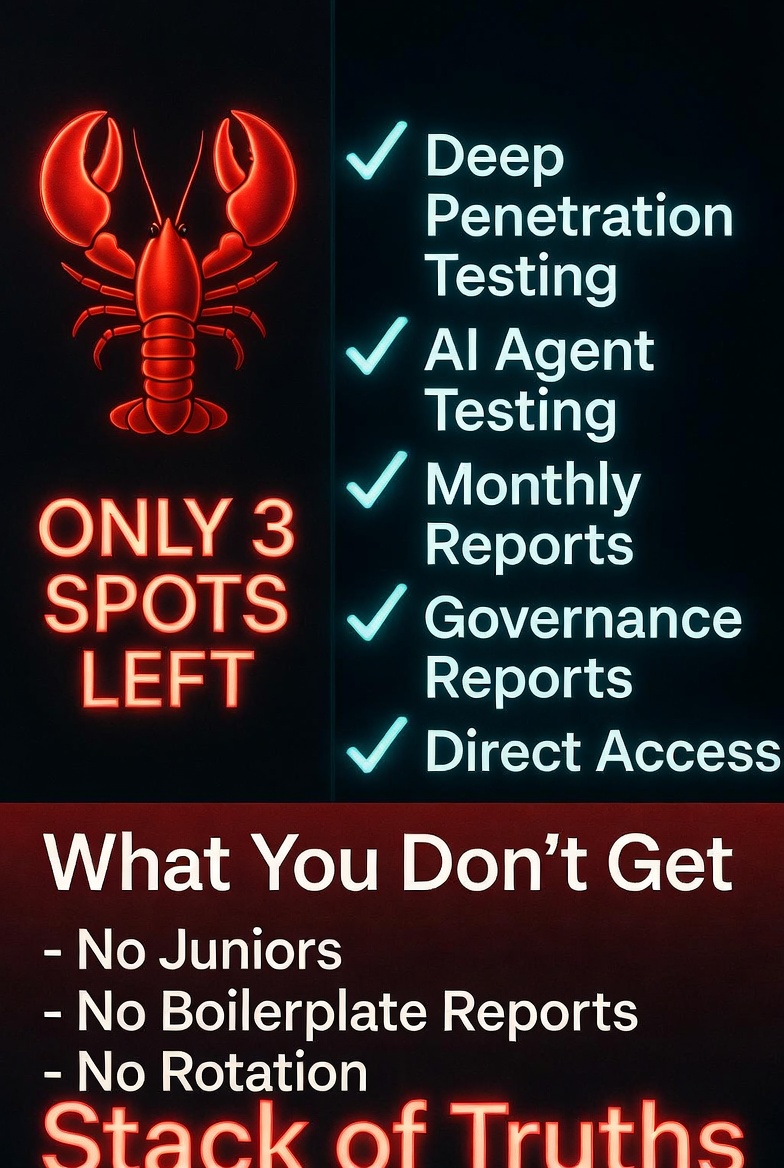
Full AI Agent Pentest: €3,000. Website pentest: €299–€1,499. Security retainer: €1,500/month.
📩 DM @StackOfTruths on XFree 15-min consultation. No hard sell. Just honest answers about what you’re not seeing.



















Leave a Reply