
Your Peace Sign Is Leaking Your Fingerprints — And AI Just Made It Worse
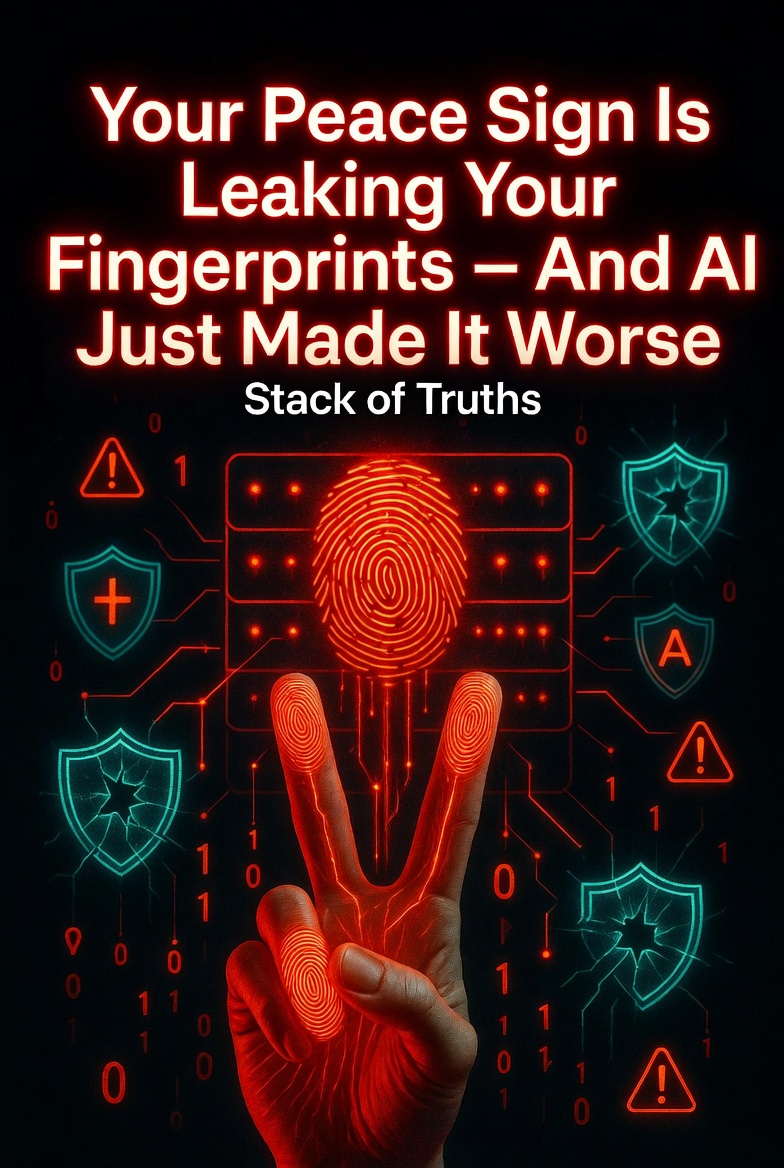
You smile. You raise two fingers. Peace sign. Click. Upload to Instagram. A million likes.
Somewhere, a piece of software is looking at your fingertips. It sees the ridges. The loops. The arches. It’s building a map of your fingerprint — without you ever touching a scanner.
This isn’t science fiction. It’s been possible since 2013. And AI just made it easier.
A high-resolution photo from 1.5 meters contains enough detail to reconstruct a usable fingerprint. Modern phone cameras and AI enhancement tools have turned every peace sign selfie into a potential biometric leak. And unlike a password, you can’t change your fingers.
The Attack — How a Selfie Becomes a Fingerprint
In 2013, researcher Jan Krissler (aka Starbug) lifted a German defense minister’s thumbprint from a 300‑DPI photo taken at a press conference. That was twelve years ago. Cameras then were garbage compared to today.
Now? Your phone has 48 megapixels, AI enhancement built into the camera app, and social media platforms that don’t strip metadata. The attack is easier. The results are sharper.
Krissler used a standard digital camera, basic software, and a photo taken from 3 meters away. He reconstructed the minister’s thumbprint well enough to unlock a phone.
If he could do it in 2013 with old tech, imagine what’s possible now with 4K video, 100MP sensors, and AI upscaling.
The Risks — What Actually Happens Next
Let’s separate panic from practicality.
✅ Real risks (for some people)
- High‑value targets — executives, activists, journalists, criminals. If someone wants your fingerprint, they can probably get it from your social media.
- Unlocking older devices — phones without liveness detection (iPhone 5S, early Android) are vulnerable to 2D printed copies.
- Physical access scenarios — an attacker with your printed fingerprint can unlock your device if they also have your phone.
❌ Overblown fears (for most people)
- Modern iPhones (iPhone 6 and later) use capacitive or ultrasonic sensors that detect blood flow, skin temperature, and sub‑dermal features. A printed 2D copy won’t work.
- Most phones require a full, centered, high‑quality print. A partial ridge from a selfie is not enough.
- The attacker needs both your fingerprint and physical access to your device. That’s a high bar.
The risk isn’t today. It’s tomorrow. Cameras keep improving. AI keeps improving. Liveness detection? Attackers will find ways around it eventually.
And fingerprints are forever. You can’t reset them like a password. Once your prints are in the wild, they’re in the wild for life.
The Real Problem — You Can’t Change Your Fingers
Passwords get leaked. You change them. Credit cards get stolen. You cancel them. Fingerprints get stolen. You’re done. You have ten fingers. That’s it.
Biometrics are convenient. They are not secure. They are not revocable. And once they’re out, every device that uses fingerprints as authentication is permanently weakened.
✅ Stop posting high‑res selfies with fingers extended toward the lens. Peace sign? Thumbs up? Pointing at the camera? Risky.
✅ Use a fist or hide your fingertips in public photos.
✅ Use Face ID (Apple) or a strong passcode instead of fingerprints for high‑value devices.
✅ Assume your fingerprints are already exposed if you’ve ever touched a glass, a phone screen, or a door handle. They’re everywhere.
✅ Enable “Attention Aware” features on Face ID to require eye contact — harder to spoof.
The Bottom Line
Your peace sign selfie is not going to get your bank account drained tomorrow. But the technology is advancing faster than the defenses.
In 2013, it took a specialist with expensive software. In 2026, anyone with a free AI upscaler and a social media account can try.
By 2030? It’ll be an Instagram filter.
Fingerprints are not passwords. You can’t change them. Stop leaking them for likes.
Your biometrics are forever. Your security shouldn’t be an afterthought.
Full AI Agent Pentest: €3,000. Website pentest: €299–€1,499. Security retainer: €1,500/month.
📩 DM @StackOfTruths on XFree 15-min consultation. No hard sell. Just honest answers about your real exposure.













Leave a Reply