
Every Bridge Hack Follows the Same Playbook — Alephium Was Just the Latest
Seven minutes. $815,000 gone. No alarms. No warnings. Just a bridge that worked exactly as designed — right up until it didn’t.
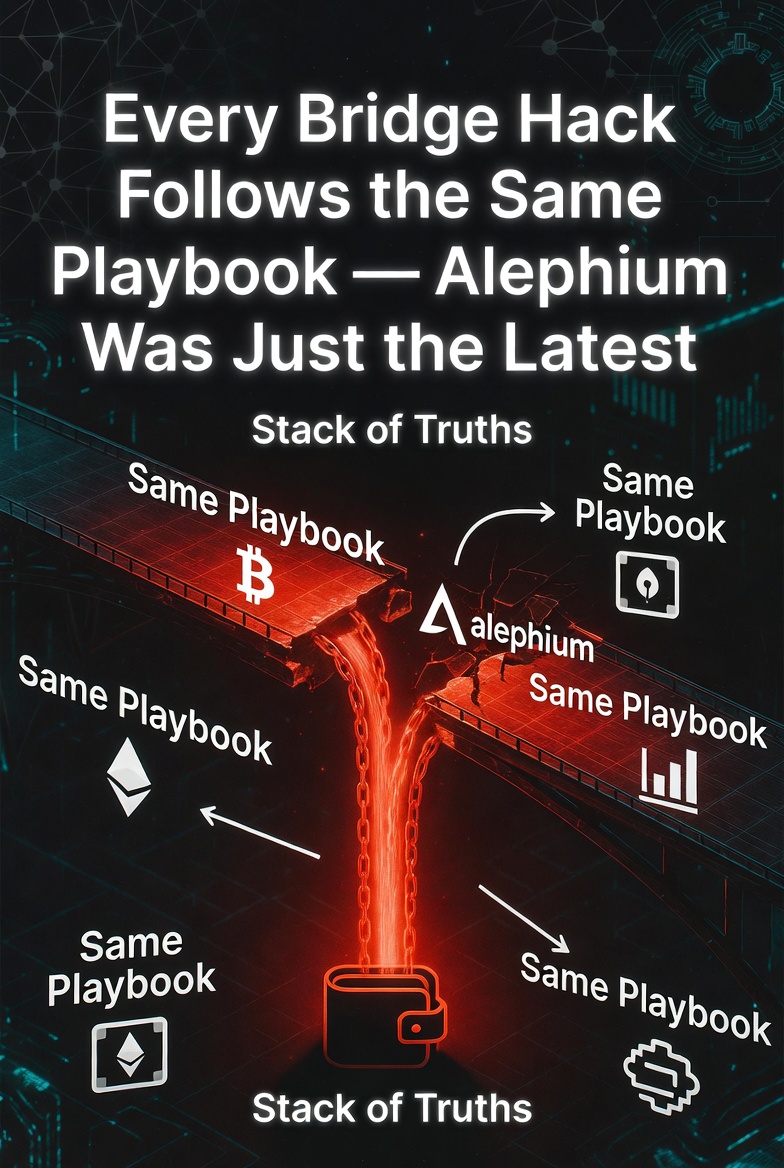
The Alephium TokenBridge hack wasn’t novel. It wasn’t sophisticated. It was the same pattern we’ve seen a dozen times before. Compromise the guardians, forge the VAAs, drain the pool.
Same playbook. Different chain. New victims.
Every bridge hack follows the same script. Attackers don’t break the smart contract. They break the people holding the keys. Until someone audits the guardians, this will keep happening. Over and over.
The Alephium Hack — 7 Minutes, $815k
On May 28, 2026, Blockaid flagged a fast-moving exploit on the Alephium TokenBridge smart contract on Ethereum. The damage:
- 13.76 million wrapped ALPH minted — over 100% of the prior supply
- USDT, USDC, WBTC, and WETH unlocked from custody
- Total drained: approximately $815,000
- Entire attack: 7 minutes
The exploiter address still holds most of the stolen funds. The project is still scrambling to respond.
• Wormhole (2022): $321M — 3-of-4 guardians compromised?
• Ronin (2022): $625M — 5-of-9 validators compromised
• Orbit Chain (2023): $81M — similar multisig compromise
• Alephium (2026): $815k — 3-of-4 guardian keys compromised
Same pattern. Different names. No one learns.
How It Works — The Guardian Problem
Most token bridges rely on a multisig of “guardians” or “validators.” These are trusted entities that sign off on cross‑chain messages. The security model assumes that enough of these guardians will stay honest.
The attack is simple:
The bridge contract worked exactly as designed. The signatures were valid. The VAAs were correctly formatted. The only thing that failed was the assumption that guardians would stay secure.
You don’t need to hack the code. You just need to hack the key holders.
Why This Keeps Happening
- Trusted guardians are a single point of failure. 3-of-4 sounds safe until you realize all 4 keys are stored in similar environments.
- No independent audit of guardian security. Projects audit the smart contract. They don’t audit the people holding the keys.
- No rotation of guardians. The same entities hold keys for years. Attackers have time to plan.
- Phishing still works. A convincing email. A fake calendar invite. A Slack message. That’s all it takes.
✅ Smart contract review — standard
✅ Guardian key storage audit — how are keys stored? Who has access?
✅ Social engineering test — can we get a guardian to leak their key?
✅ Fallback analysis — what happens if 3-of-4 are compromised?
✅ Incident response simulation — how fast can you rotate keys?
What Needs to Change
- ✅ Move toward ZK bridges. Cryptographic proofs instead of trusted guardians. No keys to steal.
- ✅ Rotate guardians regularly. Don’t let the same entities hold keys for years.
- ✅ HSM all guardian keys. Hardware security modules, not cloud KMS.
- ✅ Run social engineering tests. Call your guardians. See if they leak.
- ✅ Assume compromise. Build fallback mechanisms. Fast key rotation. Circuit breakers.
Alephium lost $815k in 7 minutes. Wormhole lost $321M. Ronin lost $625M. Same pattern. Every time.
The industry keeps auditing the code. Nobody audits the guardians.
Until that changes, every bridge is a ticking time bomb.
The Bottom Line
Seven minutes. $815,000. Three compromised keys.
The Alephium bridge wasn’t broken by a smart contract bug. It was broken by the same human vulnerability that’s been exploited for years.
You can’t audit your way out of trusting the wrong people.
Audit the guardians. Test the key holders. Assume someone is already inside. Because with every bridge hack, someone is.
Think your bridge is secure? Let’s test the guardians.
Full bridge security audit: custom quote. Social engineering test: included in retainer.
📩 DM @StackOfTruths on XFree 15-min consultation. No hard sell. Just honest answers about your guardian security.















Leave a Reply