
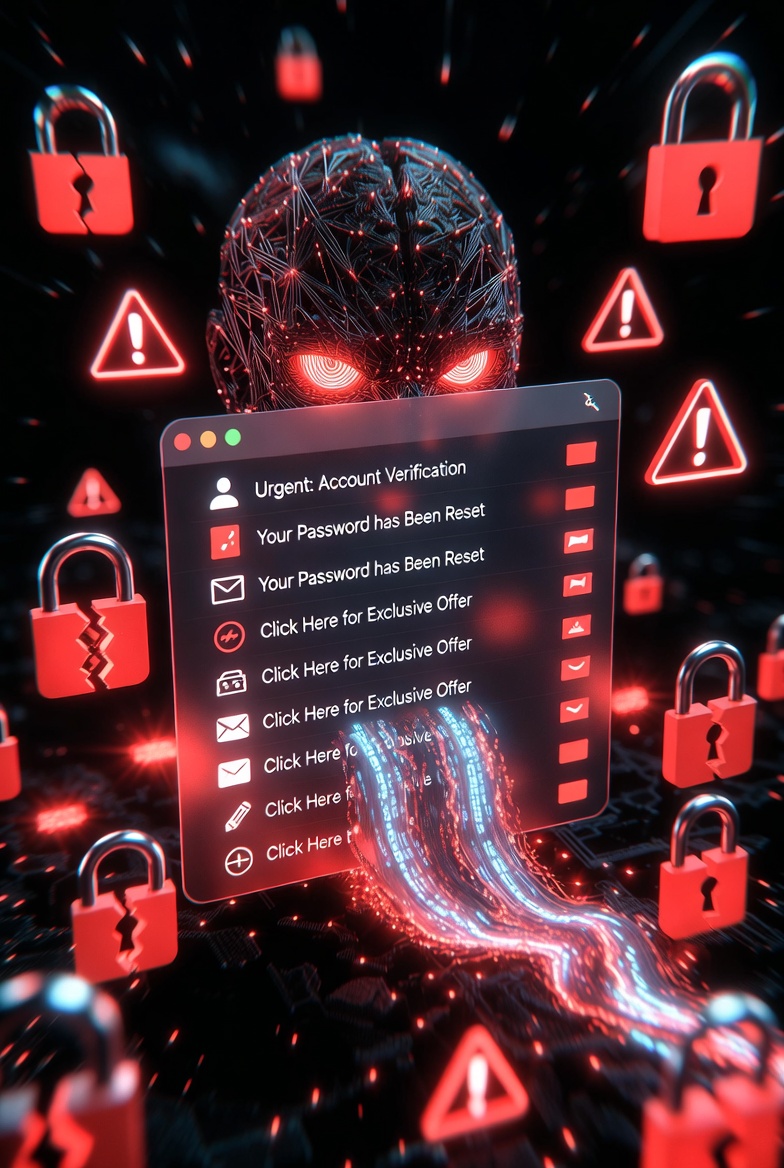
The New Phishing:
Why AI Made Your Inbox Deadly
One link. That’s all it takes. One employee clicks one “urgent” email. Your API keys, your database, your entire infrastructure — gone in minutes.
Phishing isn’t sophisticated. It’s effective. And AI just made it 100x more convincing.
90% of successful breaches start with a phishing email. Not zero‑days. Not complex exploits. Just a human being tricked into clicking something they shouldn’t. The old advice — “look for spelling mistakes” — is dead. AI killed it.
How AI Changed the Game
Five years ago, phishing emails were easy to spot: bad grammar, weird formatting, “Nigerian prince” vibes. Today, AI tools like ChatGPT, Grok, and Claude generate near‑perfect emails with:
- ✅ Flawless grammar and native‑sounding phrasing
- ✅ Your CEO’s exact writing style (scraped from LinkedIn, blog posts, or public interviews)
- ✅ Internal context stolen from compromised email threads or data leaks
- ✅ Fake domains that differ by ONE character (rnicrosoft.com vs microsoft.com)
Attackers now run entire phishing campaigns automated by AI agents. One script kiddie with a $20 API key can send 10,000 personalized emails per hour — each one tailored to the recipient’s role, company, and recent activity.
The New Phishing Landscape
| Old Phishing (Pre‑AI) | New Phishing (2026) |
|---|---|
| Spelling mistakes, bad grammar | Perfect English, professional tone |
| Generic “Dear customer” | Personalized with your name, role, recent purchase |
| Obvious fake sender | Spoofed domain or lookalike (rnicrosoft.com) |
| Manual, slow, low volume | AI‑driven, 10k+ emails/hour, adaptive |
The One That Almost Got a Client
Last month, a mid‑sized SaaS company came to me after almost losing $187,000. Their CFO received an email that looked exactly like it came from the CEO: same writing style, same signature, even referencing a real ongoing acquisition discussion. The email asked for an urgent wire transfer to a “new vendor account.”
The only reason they didn’t lose the money? The CFO picked up the phone and called the CEO. The CEO had no idea what she was talking about.
That email was 100% AI‑generated. The attacker had scraped the CEO’s LinkedIn, the company’s press releases, and a few internal email threads from a previous unrelated breach. The result? A perfect spear‑phishing weapon.
What Works Now (Actionable Defenses)
- Never click links in unexpected emails — Even if it looks like your boss. Even if it’s urgent. Type the URL manually or use a bookmarked link.
- Verify through a different channel — Call, Slack, Teams, or in person. A 30‑second phone call stops 99% of wire fraud.
- Assume every email is hostile until proven otherwise — Paranoid? Maybe. Hacked? Not you.
- Train your team monthly — Not yearly. Not quarterly. Monthly. And test them with simulated phishing campaigns.
- Reward the ones who report correctly — Positive reinforcement works better than punishment.
- Implement DMARC, DKIM, and SPF — Makes it harder for attackers to spoof your domain. Not a silver bullet, but raises the bar.
- Use hardware security keys (FIDO2/WebAuthn) — Phishing‑resistant MFA. Even if they steal your password, they can’t log in without the physical key.
The Human Factor
Technology alone will never solve phishing. You can buy the best email filters, the most expensive security awareness platform, and still lose because someone was tired, distracted, or just trying to be helpful.
Cybersecurity is a team sport. Your IT team can build the walls, but every single employee guards the gate. Train them. Test them. And when they fail (because someone will), don’t punish — teach.
🔥 Real talk: I’ve pentested over 40 companies. The ones that never get phished? They don’t exist. The ones that recover fast? They have incident response plans, quick reporting culture, and zero blame. That’s the difference.
Your 5‑Minute Phishing Checkup
- ✅ Do you have DMARC/DKIM/SPF configured? (Check with a free tool like dmarcly.com)
- ✅ Does your team know how to report a suspicious email? (One click to IT security?)
- ✅ Have you run a simulated phishing test in the last 90 days?
- ✅ Do you use FIDO2 keys for critical accounts? (Google, Microsoft, GitHub, AWS support them)
- ✅ Is there a clear “no money transfer without voice confirmation” policy for finance people?
If you answered “no” to more than one of these, you have work to do. Don’t panic. Just start.
The Bottom Line
AI didn’t invent phishing. It just supercharged it. The same tools that help you write emails, generate code, and analyze data are now in the hands of attackers — often at the same time, from the same API endpoints.
You can’t tech your way out of this one. You need:
- 🔐 Strong technical controls (DMARC, MFA, allow‑listing)
- 🧠 A trained, alert team that knows how to pause and verify
- 📋 A no‑blame reporting culture that catches mistakes early
The attackers are using AI. So should your defenders. But the first line of defense is still a human who knows when to stop, think, and call to verify.
Stay paranoid. Stay safe. 🦞
Want to test your team’s phishing readiness?
I run simulated phishing campaigns and security awareness training for companies that want to stop losing sleep over one wrong click.
✉️ Direct message me — say “phishing test” and we’ll set up a no‑pressure chat.
📩 DM @StackOfTruths on XNo bots. No sales scripts. Just a pentester who’s seen it all.













Leave a Reply