
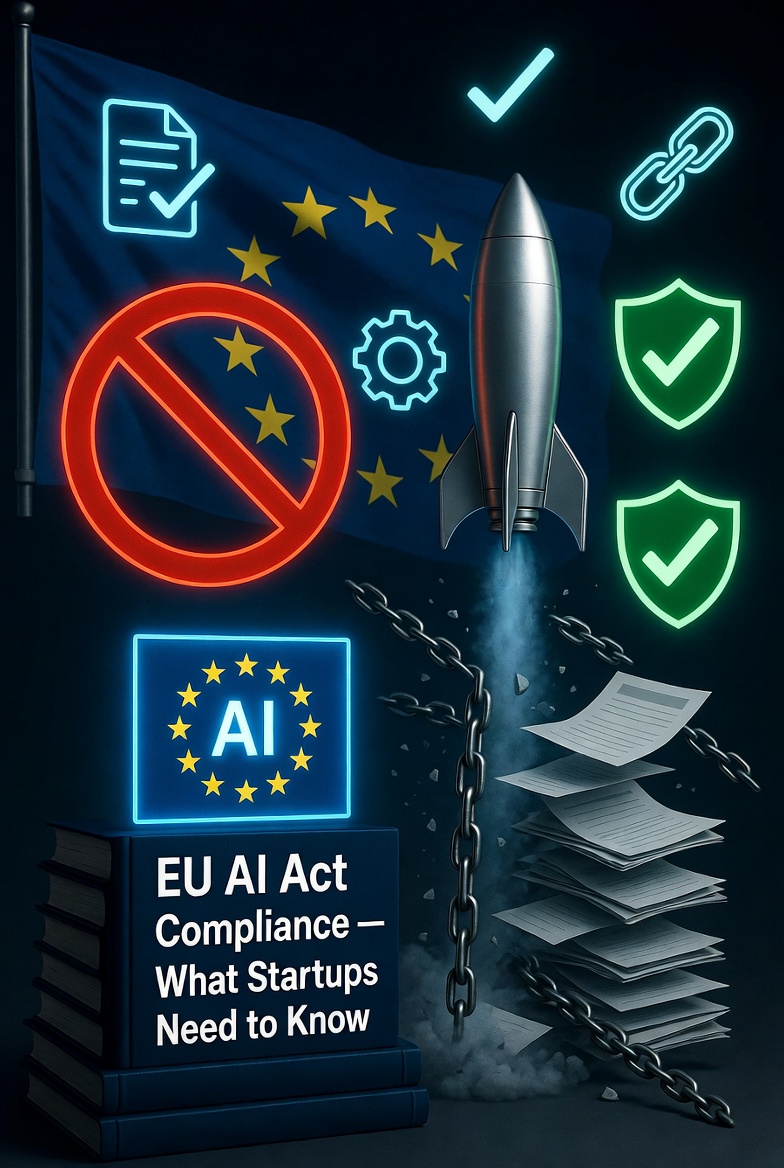
EU AI Act Compliance — What Startups Need to Know ✓ Stack of Truths Compliant
The European Union AI Act (Regulation (EU) 2024/1689) is here. It’s not coming — it’s already enforceable. And if you’re building or deploying AI systems in the EU (or serving EU customers), you need to comply. Yesterday.
Fines? Up to €35 million or 7% of global annual turnover — whichever is higher. That’s more than GDPR.
But here’s the good news: compliance isn’t as scary as it sounds. And if you’re already working with Stack of Truths, you’re ahead of the curve.
What Is the EU AI Act?
The EU AI Act is the world’s first comprehensive AI law. It regulates AI systems based on risk level:
- Unacceptable risk — Banned outright (social scoring, subliminal manipulation, real-time biometric surveillance in public spaces)
- High risk — Strict requirements (critical infrastructure, employment, education, law enforcement, migration, justice)
- Limited risk — Transparency obligations (chatbots, deepfakes, emotion recognition)
- Minimal risk — No requirements (spam filters, video games, AI-enabled recommendation engines)
If your AI system falls into the high-risk category, you need to comply with Articles 8-15: risk management, data governance, technical documentation, transparency, human oversight, robustness, accuracy, and cybersecurity.
Does This Apply to You?
Yes, if:
- You place AI systems on the EU market (even if based outside the EU)
- You use AI systems in the EU (even if your company is outside)
- Your AI system’s output affects people in the EU
That covers most B2B and B2C AI startups serving European customers.
Key Articles You Need to Know
| Article | Requirement | Deadline |
|---|---|---|
| Article 5 | Prohibited AI practices (banned immediately) | Feb 2025 ✓ |
| Article 8-15 | High-risk AI requirements | Aug 2026 |
| Article 13 | Transparency & user information | Aug 2026 |
| Article 14 | Human oversight (design & deploy) | Aug 2026 |
| Article 15 | Accuracy, robustness & cybersecurity | Aug 2026 |
| Article 17 | Quality management system | Aug 2026 |
| Article 29 | Post-market monitoring | Aug 2026 |
| Article 43 | Conformity assessment (third-party for some AI) | Aug 2026 |
| Articles 53-55 | General Purpose AI (GPAI) — foundation models | Aug 2025 ✓ |
Article 5 — Prohibited AI (Already Illegal)
These are banned immediately. Do not build or deploy:
- Subliminal manipulation causing harm
- Exploitation of vulnerabilities of specific groups (age, disability)
- Social scoring by public authorities
- Real-time remote biometric identification in public spaces (with narrow exceptions)
- Emotion recognition in workplace/education (except medical/safety)
- Predictive policing based on profiling (location, past behavior)
- Biometric categorization for sensitive characteristics (race, political views, religion)
- Untargeted scraping of facial images from internet/CCTV
Stack of Truths will not test or support AI systems engaged in prohibited practices. If we discover a client’s AI engages in these, we terminate the engagement immediately and may report to supervisory authorities.
Article 13 — Transparency & User Information
Your AI system must be transparent. Users need to know:
- They’re interacting with an AI system (not a human)
- The system’s capabilities and limitations
- The intended purpose of the system
- How decisions are made (to the extent feasible)
How Stack of Truths helps: Our AI pentest reports include transparency gap analysis. We identify where your system fails to meet Article 13 requirements and provide remediation steps.
Article 14 — Human Oversight
High-risk AI systems must be designed for effective human oversight. That means:
- Humans can understand the AI’s output
- Humans can override or ignore AI decisions
- Humans can intervene when the AI behaves unexpectedly
- No fully automated decision-making without human review
How Stack of Truths helps: I personally review every finding before it reaches your report — no raw AI output. This is human oversight in action. Our pentests also evaluate whether your system allows adequate human control.
// Example: Human oversight check in your AI agent
def execute_tool_call(tool_name, params, require_approval=True):
    if require_approval and tool_name in ["transfer_funds", "delete_user", "send_email"]:
        human_input = input(f"Approve {tool_name} with params {params}? (y/n): ")
        if human_input.lower() != 'y':
            return {"error": "Human rejected"}
    return call_tool(tool_name, params)
Article 15 — Accuracy, Robustness & Cybersecurity
This is where Stack of Truths specializes. The EU AI Act requires:
- Accuracy: Your AI system performs as intended (with documented accuracy metrics)
- Robustness: Your AI system handles errors, failures, and adversarial inputs
- Cybersecurity: Your AI system is protected against manipulation and attacks
Article 15 explicitly calls out prompt injection, data poisoning, and model evasion as threats that must be mitigated.
- ✅ Prompt injection (20+ vectors) — Article 15 cybersecurity
- ✅ Data exfiltration — Article 15 robustness
- ✅ Tool chain abuse — Article 15 cybersecurity
- ✅ Adversarial inputs — Article 15 robustness
Article 29 — Post-Market Monitoring
Compliance isn’t one-time. Article 29 requires continuous monitoring of AI systems after deployment. You need to:
- Regularly test for new vulnerabilities
- Monitor performance over time
- Report serious incidents to authorities
- Update documentation as the system evolves
How Stack of Truths helps: Our Security Retainer (€1,500/month) provides quarterly pentests, monthly vulnerability scans, and incident response — exactly what Article 29 demands for ongoing compliance.
Articles 53-55 — General Purpose AI (Foundation Models)
If you’re using GPT-4, Claude, Llama, Gemini, or similar foundation models, you have additional obligations:
- Document model capabilities and limitations
- Comply with copyright and transparency requirements
- Implement cybersecurity safeguards
- Assess and mitigate systemic risks (for very large models)
How Stack of Truths helps: Our AI pentests evaluate how you’ve secured your foundation model integration — including API key protection, prompt injection mitigations, and output filtering.
How Stack of Truths Supports Your Compliance Journey
I’ve designed every service to align with EU AI Act requirements. Here’s how:
| Service | EU AI Act Article | What You Get |
|---|---|---|
| Lite AI Pentest (€750) | Art 15 (cybersecurity) | Basic prompt injection, API key exposure, quick fixes |
| Full AI Pentest (€3,000) | Art 13-15, 29 | 40+ page report mapped to NIST AI RMF, debrief |
| AI Red Team (€5,000) | Art 13-15, 29, 43 | 2 weeks adversarial testing, conformity evidence |
| Security Retainer (€1,500/month) | Art 29 (post-market monitoring) | Quarterly pentests, monthly scans, incident response |
- ✓ All AI pentests manually validated — no automated-only findings
- ✓ NIST AI RMF-aligned methodology (maps to EU AI Act)
- ✓ GPG-signed, tamper-proof reports — audit-ready
- ✓ GDPR compliant data processing (based in The Netherlands)
- ✓ Will not test prohibited AI systems (Article 5)
- ✓ Retainer provides continuous monitoring (Article 29)
What You Should Do Right Now
- Classify your AI system — Is it high-risk under the EU AI Act? (Annex III lists high-risk use cases)
- Document everything — The Act requires technical documentation (Article 11). Start now.
- Get a baseline pentest — You can’t prove cybersecurity compliance without testing.
- Implement continuous monitoring — Annual tests won’t satisfy Article 29.
- Work with compliant vendors — Stack of Truths is EU AI Act compliant and based in The Netherlands.
The Bottom Line
The EU AI Act isn’t optional. It’s the law. And unlike GDPR, which many companies ignored until fines started landing, this one has teeth from day one.
But here’s the secret: compliance isn’t about ticking boxes. It’s about building AI systems that are actually secure, transparent, and trustworthy. That’s what I help you do anyway.
If you’re already working with Stack of Truths, you’re ahead. If you’re not — let’s talk. I’ll help you understand where you stand, what you need to fix, and how to stay compliant without burning your budget.
Don’t be the first startup fined €35 million because you didn’t test for prompt injection.
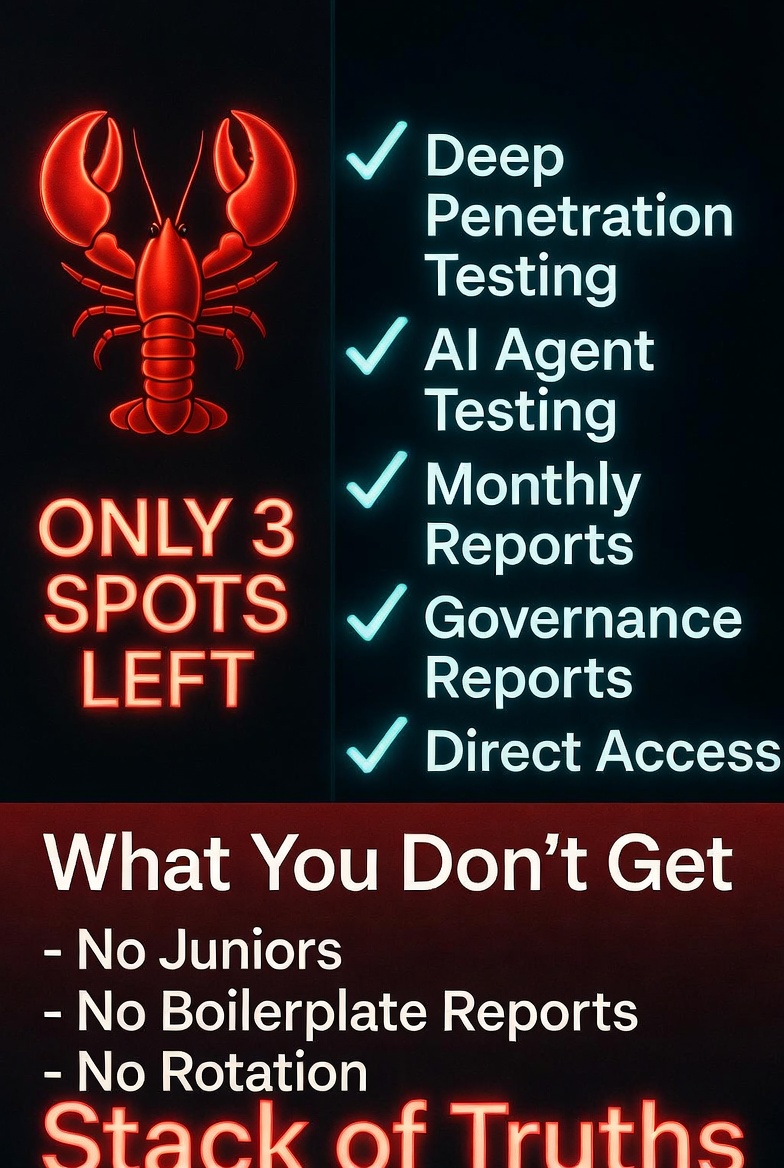
🦞 Need help with EU AI Act compliance?
I offer AI penetration testing that maps directly to Articles 13-15 and 29. DM me first. Quick chat. Then we book a call if we’re a fit.
No Calendly. Just a human who breaks AI agents (and helps you stay compliant). Based in The Netherlands 🇳🇱



















Leave a Reply