

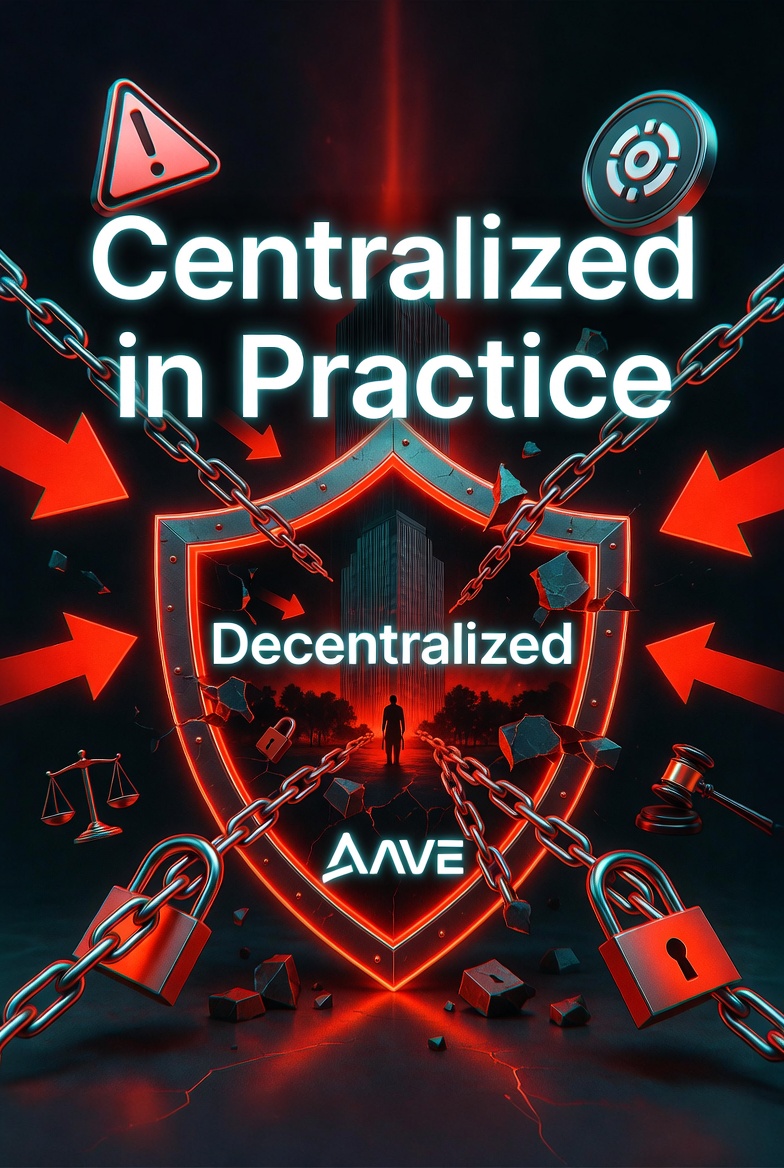
How $250M Vanished from AAVE
Let’s walk through the attack step by step. No complex math. No code you don’t need. Just the chain of failures that let someone walk away with a quarter of a billion dollars in ETH.
Read that again. Not a smart contract bug. Not a flash loan exploit. The system worked exactly as designed — and that was the problem.
🔍 The vulnerability wasn’t in the smart contract. It was in the oracle of trust around collateral.
Decentralization theater
AAVE is supposed to be decentralized finance. But here’s the uncomfortable truth: management decides which assets qualify as collateral. That’s not a protocol rule — it’s a human decision wrapped in smart contracts.
One bad decision. One forged asset. And the entire house of cards collapsed.
What actually broke
Most people think DeFi hacks are about clever code exploits. This one wasn’t. The attacker didn’t break cryptography or find a zero-day in Solidity. They just faked an asset that management had already approved.
The protocol looked at the asset, checked its approval, and said “looks good.” No further questions. Because the system was built to trust the approval, not verify the asset continuously.
| ❌ What most people think | ✅ What actually happened |
|---|---|
| Smart contract bug | Management approved an asset |
| Flash loan exploit | Attacker forged that exact asset |
| Math overflow / underflow | Protocol trusted the approval blindly |
| Oracle manipulation | $250M gone |
The oracle of trust
In DeFi, an “oracle” usually means a price feed. But there’s another oracle nobody talks about: the oracle of trust around collateral. Who decides what’s legitimate? How is that decision verified? What happens when that decision is wrong?
AAVE’s answer to all three questions was “trust management.” And that trust cost $250M.
📌 Decentralization means nothing if the inputs can be gamed by one bad actor — or one bad management call.
Why this matters for AI agents
You might be thinking: “I don’t run a DeFi protocol. Why should I care?”
Because the same pattern is everywhere:
- AI agents with tool access — who decides which tools they can call? One bad approval = agent deletes your database.
- API key management — who decides which keys are safe? One bad approval = attacker drains your credits.
- Prompt approval systems — who decides which prompts are allowed? One bad approval = jailbreak success.
The AAVE attack wasn’t about crypto. It was about trust without verification. And that’s a problem in every system where humans approve things and machines execute blindly.
The fix isn’t more code
Adding more smart contracts wouldn’t have stopped this attack. The attacker didn’t exploit a missing feature. They exploited a missing verification step between “management approved” and “protocol executed.”
What would have helped?
- 🔐 Continuous verification — not just “is this approved?” but “is this STILL legitimate?”
- 🔐 Multi-party approval — no single management decision should be enough to move $250M
- 🔐 Runtime asset verification — check the asset’s authenticity at borrow time, not just at registration time
The pattern keeps repeating
FTX? Management decision. Celsius? Management decision. AAVE’s $250M loss? Management decision dressed up as a protocol.
The name changes. The technology changes. But the vulnerability is always the same: someone with authority makes a call, and the system executes without asking “are you sure?”
Until we build systems that verify continuously — not just at approval time — we’ll keep reading these headlines.
Don’t let your AI agent be the next headline
I break AI agents before attackers do. Prompt injection, tool call abuse, privilege escalation — I find the signal in the noise.
📩 DM @StackOfTruths on XFree 15-min consultation. No hard sell. Just honest answers about your AI agent security.
















Leave a Reply