
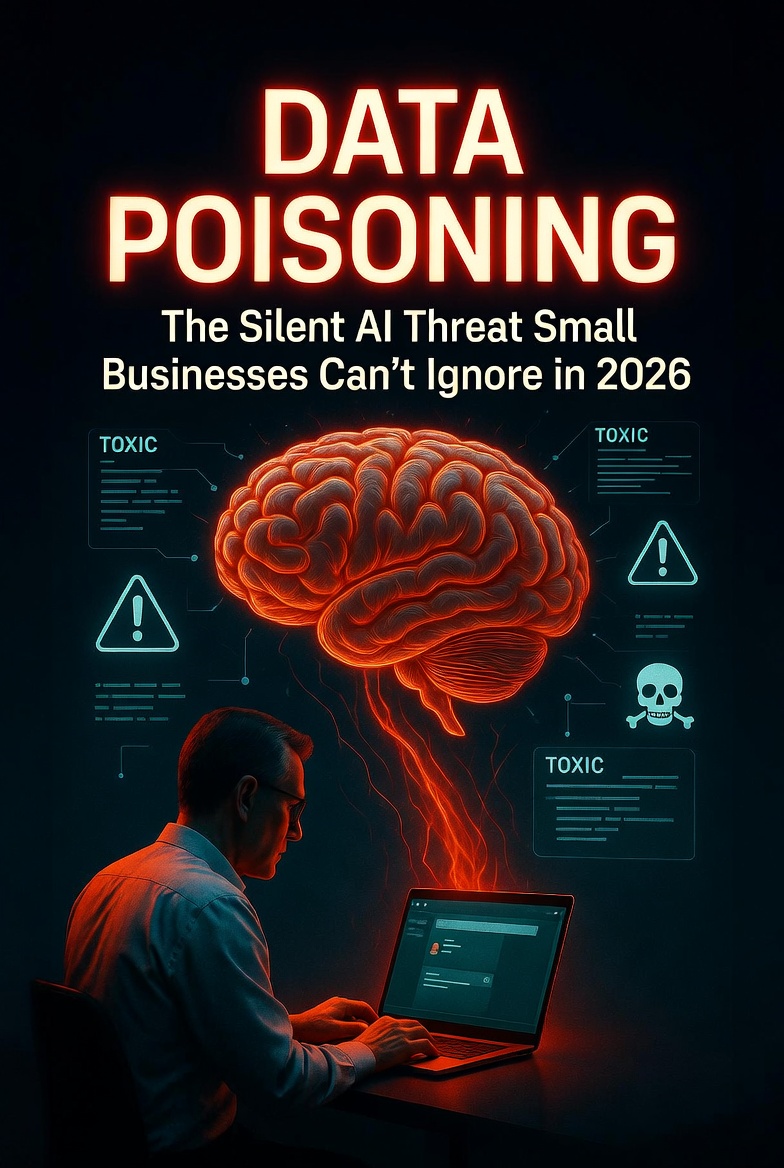
Data Poisoning: The Silent AI Threat Small Businesses Can’t Ignore in 2026
Data poisoning has moved from theoretical research to a real-world concern. Anti-AI groups use tools like Nightshade to corrupt scraped training data, while malicious actors treat it as a stealthy cyber weapon. For small businesses using AI chatbots, image tools, customer analytics, or automation, the risk is no longer hypothetical.
Even a small amount of poisoned data — sometimes just a few hundred crafted examples — can cause models to hallucinate, misclassify threats, introduce backdoors, or quietly degrade performance.
What Is Data Poisoning?
Data poisoning involves deliberately injecting misleading, corrupted, or adversarial examples into the datasets used to train or fine-tune AI models. Once learned, these flaws become part of the model itself, making them hard to detect and remove.
Artists fighting unauthorized use of their work deploy Nightshade (offensive poisoning) and Glaze (style protection). These tools add imperceptible changes to images that can disrupt how generative AI learns concepts.
Beyond activism, cybercriminals use similar techniques through compromised public datasets, user-generated content, or supply-chain attacks. In 2026, OWASP and cybersecurity experts list data poisoning as a top AI risk.
Why Small Businesses Are Vulnerable
Most small businesses don’t train giant foundation models, but exposure happens when you:
- Use consumer-grade or free AI tools that rely on public web data
- Fine-tune open-source models on your own customer photos, documents, or feedback
- Integrate third-party AI services without strong data validation
⚠️ A poisoned model can slowly start giving unreliable advice, missing fraud patterns, generating inconsistent outputs, or behaving unpredictably — damaging trust and operations long before you notice.
Practical Defenses Small Businesses Can Implement Today
You don’t need a dedicated security team. Focus on reducing exposure and maintaining basic hygiene.
1. Choose Trusted Enterprise AI Tools
Upgrade to business/enterprise versions of ChatGPT Enterprise, Claude Teams, Google Gemini for Workspace, or Azure OpenAI. These platforms invest in robust data curation and poisoning mitigation.
2. Secure Your Own Data and Fine-Tuning
- Validate and sanitize datasets before any training or fine-tuning
- Enforce strict access controls — limit who can upload training data
- Track data provenance (know exactly where every piece of data originates)
- Avoid blind web scraping, especially for image or media datasets
3. Monitor for Signs of Trouble
Watch for model drift: sudden increases in hallucinations, inconsistent answers, or unexpected biases. Run occasional tests with edge-case inputs and keep humans reviewing critical outputs.
4. Build Simple AI Governance
Create a short internal AI usage policy. Train your team on risks. Use data version control tools where possible and consider periodic resets to known clean model states.
• Audit all AI tools currently in use
• Switch to business-tier plans where practical
• Document data sources for any custom AI work
• Schedule regular reviews of important AI outputs
The Ongoing Arms Race
AI developers continue improving detection, adversarial training, and provenance tracking. Meanwhile, tools like Nightshade show how easily public data can be influenced. For small businesses, the winning strategy is caution: minimize use of unverified public data and favor reputable, controlled platforms.
“Prevention is far easier than remediation. Once poisoned, cleaning a model is extremely difficult — treat your training data with the same care you give financial records.”
Final Thoughts
Data poisoning won’t collapse the entire AI industry, but it represents a real and growing vulnerability that can quietly erode performance and trust. By taking straightforward protective measures now, small businesses can safely harness AI’s benefits while avoiding hidden pitfalls in 2026 and beyond.
Stay informed, stay cautious, and apply the same security mindset to AI that you already use for the rest of your tech stack.
Worried about your AI’s security?
AI agent pentesting. Prompt injection. API exploitation. Data poisoning assessments. I find what automated scanners miss.
📩 DM @StackOfTruths on XFree 15-min consultation. No hard sell. Just honest answers about your AI agent security.
















Leave a Reply