
Cursor AI Flaw: Remote Code Execution via Malicious Git Repo
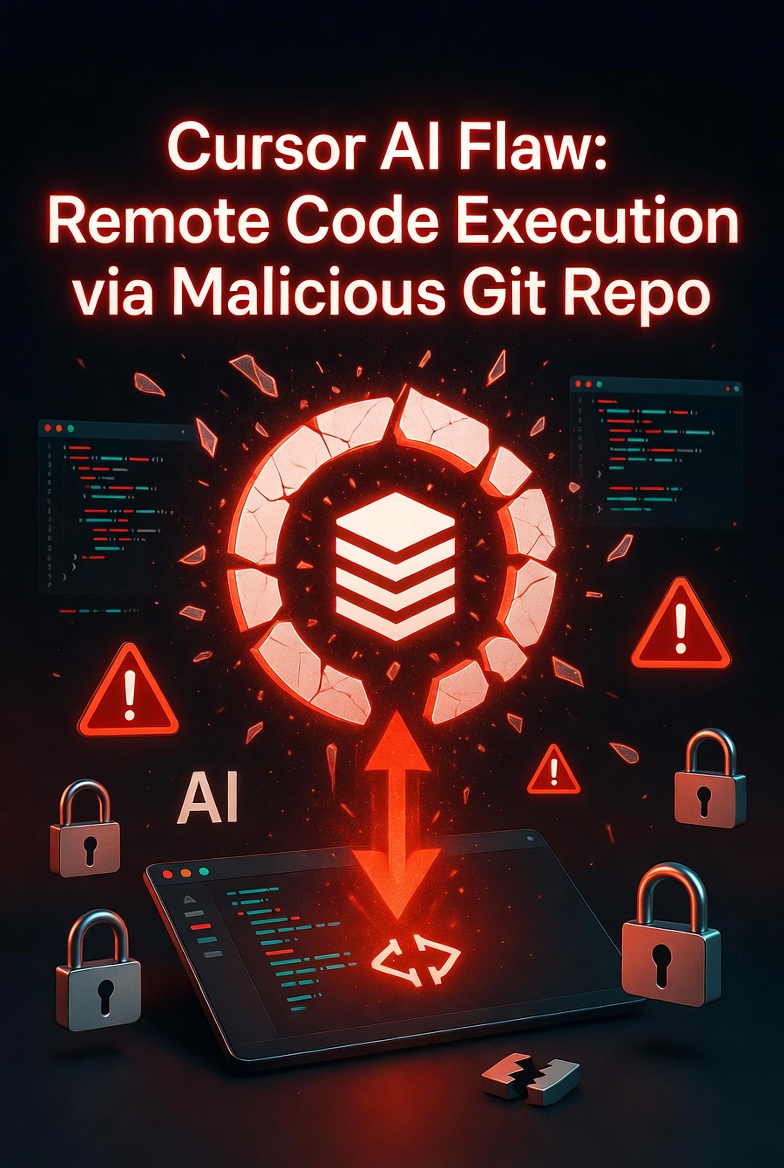
A high-severity vulnerability (CVE-2026-26268) in Cursor’s AI coding agent enables attackers to achieve remote code execution on developers’ machines simply by tricking them into cloning a malicious Git repository.
No extra clicks. No popups. The AI agent triggers it automatically during routine work.
Your AI coding assistant is now an attack vector. Clone a malicious repo → agent performs routine tasks like `git checkout` → Git hooks execute → attacker runs code on your machine.
What Is the Vulnerability?
Researchers at Novee discovered that Cursor’s AI agent automatically interacts with Git repositories in ways that trigger Git hooks — scripts that run on specific events like checkout, commit, or merge.
By embedding malicious Git hooks and bare repositories, an attacker can achieve code execution the moment the AI agent touches the repo. The exploit triggers during legitimate AI agent operations like `git checkout`, with no additional user interaction required beyond the initial clone.
This is not a theoretical flaw. It’s a live vulnerability affecting developers who use Cursor to work with public or untrusted repositories.
Developers’ machines hold the keys to the kingdom. SSH keys. Cloud tokens. API secrets. Source code. A successful exploit gives attackers access to everything.
How the Attack Works
The vulnerability leverages legitimate Git features. Hooks are intended for automation. Bare repositories are intended for collaboration. In combination with an AI agent that automatically interacts with repositories, they become a silent backdoor.
Why AI Agents Make This Worse
Traditional developers might clone a repository and review it before running commands. AI agents don’t have that caution. They see a repository and start working — checking out branches, reading files, analyzing code.
This is a new class of vulnerability: supply chain attacks through AI assistant behavior.
- No user interaction required — The agent works autonomously
- No visual warning — The agent doesn’t ask “Are you sure?”
- Widespread impact — Cursor is widely used by developers cloning public repos daily
- Silent execution — The attack happens in the background
What’s at Risk
| Asset | Impact of Compromise | Severity | \
|---|---|---|
| SSH keys | Attacker accesses all servers, repos, and infrastructure you have access to | CRITICAL |
| Cloud tokens | AWS, GCP, Azure credentials → attacker spins up resources, steals data, runs crypto miners | CRITICAL |
| API secrets | Database credentials, third-party API keys, internal service tokens → data breach imminent | CRITICAL |
| Source code | Proprietary code, trade secrets, internal tools → intellectual property theft | HIGH |
| Lateral movement | Once on your machine, attacker pivots to internal networks and other developer machines | HIGH |
What You Should Do Right Now
- Update Cursor immediately — Check for patches addressing CVE-2026-26268
- Review public repositories before cloning — Vet the source, especially if you plan to let AI agents work with the code
- Audit Git hooks in your projects — Review `.git/hooks/` for suspicious scripts
- Run AI agents in isolated environments — Consider containers or VMs for untrusted code interaction
- Monitor for unusual agent behavior — Unexpected git commands or network activity?
- Assume compromise if you’ve used Cursor with public repos — Rotate your SSH keys, cloud tokens, and API secrets as a precaution
This vulnerability isn’t about Cursor specifically. It’s about a fundamental problem: we’re giving AI agents autonomous access to our systems, but we haven’t updated our threat models.
Traditional security assumed humans would review code before executing it. AI agents don’t have that hesitation. Every public repository becomes a potential attack vector.
The next generation of supply chain attacks won’t target your code. They’ll target your AI assistant.
Want to test if your AI agents are secure?
I break AI agents — and the tools developers use every day. Full-stack security assessment for AI-assisted development environments.
📩 DM @StackOfTruths on XFree 15-min consultation. No hard sell. Just honest answers about your AI agent security.















Leave a Reply