
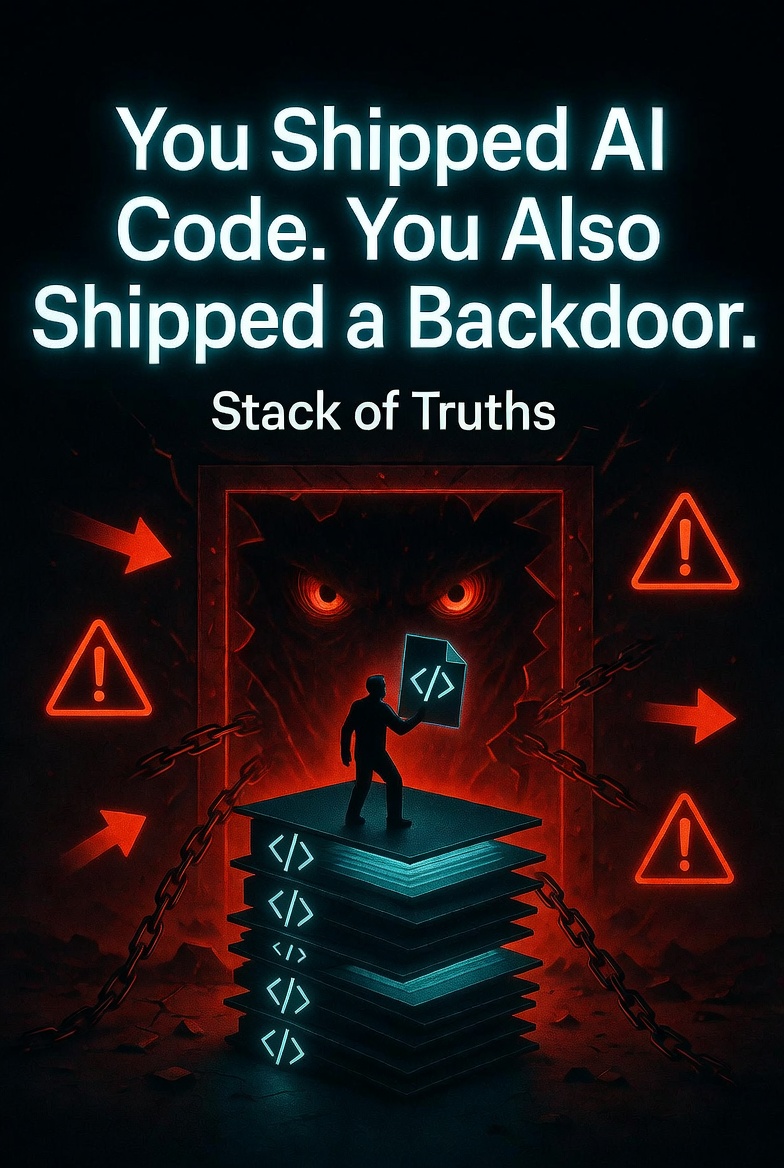
You Shipped AI Code. You Also Shipped a Backdoor.
I see it all the time. A founder types a prompt. The AI spits out code. The feature works. They ship it. They’re proud. They should be — it’s fast, it’s clever, it works.
But here’s what I also see when I look under the hood.
The code works. The feature works. The demo works. But under the hood, there’s a vulnerability waiting for someone who knows where to look.
And they are looking.
The Numbers Don’t Lie
In March 2026 alone, researchers tracked 35 CVEs directly traced back to AI-generated code. Not theory. Not “might happen.” Did happen. In production.
Nearly half of all AI-written code fails basic OWASP security tests. SQL injection. Hardcoded keys. Broken authentication. Insecure dependencies.
The code looks fine. The SQL query runs. The API responds. The login page loads.
Until someone puts a single quote in the wrong place and your database empties.
Why AI Writes This Way
Think about where AI learns to code. GitHub. Stack Overflow. Tutorial blogs. Forums. Millions of examples.
And here’s the problem: a huge chunk of that training data is insecure.
Hardcoded API keys in tutorial examples. SQL queries built with string concatenation. Old library versions with known vulnerabilities. Authentication logic that looks right but is completely wrong.
The AI doesn’t know the difference between “this works” and “this is secure.” It just sees patterns. And insecure patterns are everywhere in its training data.
So it reproduces them. Confidently. At scale. On your dime.
What Attackers Are Already Doing
I talk to clients who think AI vulnerabilities are a future problem. They’re not. Attackers are exploiting them right now.
- Prompt injection attacks — Attackers trick your AI agent into following malicious instructions
- Hardcoded secret scanning — They scrape public repos for API keys the AI left in plain sight
- SQL injection on AI-generated endpoints — The code works, but the input validation is missing
- Authentication bypass chains — The AI wrote login logic that looks correct but has a fatal flaw
- Dependency confusion attacks — The AI imported a library that doesn’t exist, so attackers created it
Attackers have built entire playbooks around AI hallucinations. They know where the models mess up. They know what to look for. And they know most founders aren’t looking.
I’ve been breaking systems for 10 years. I’ve seen what happens when founders trust AI code without testing it.
The CVE count is climbing. The breach reports are real. And most AI tools give you zero visibility into what they quietly slipped into your codebase.
Don’t wait for the breach with your company name in the headline.
What You Should Do Right Now
- Don’t trust AI-generated code — Review it. Test it. Break it. Assume it’s wrong until proven otherwise.
- Run OWASP checks on every AI-generated commit — 45% failure rate is not an exception. It’s the norm.
- Scan for hardcoded secrets — API keys, database credentials, tokens. They’re there. I find them every week.
- Test authentication logic manually — This is where AI fails most spectacularly. I’ll show you how.
- Get a real pentest — Automated scanners miss what human-led red teaming finds. I prove it daily.
The vibe is great. I get it. You’re shipping fast. You’re winning.
But the security posture? Not so much.
Let’s fix that before someone else does.
You shipped AI code. Now let me check if you shipped a backdoor.
Website pentest from $299. AI agent pentest from $750. Security retainer from $1,500/month.
📩 DM @StackOfTruths on XFree 15-min consultation. No hard sell. Just honest answers about your AI agent security.

















Leave a Reply