
Why AI Agents Can’t Replace Pentesters (Yet)
There’s a question I’ve been getting from clients lately:
“Can I just prompt an AI agent to run my pentest?”
Short answer: No.
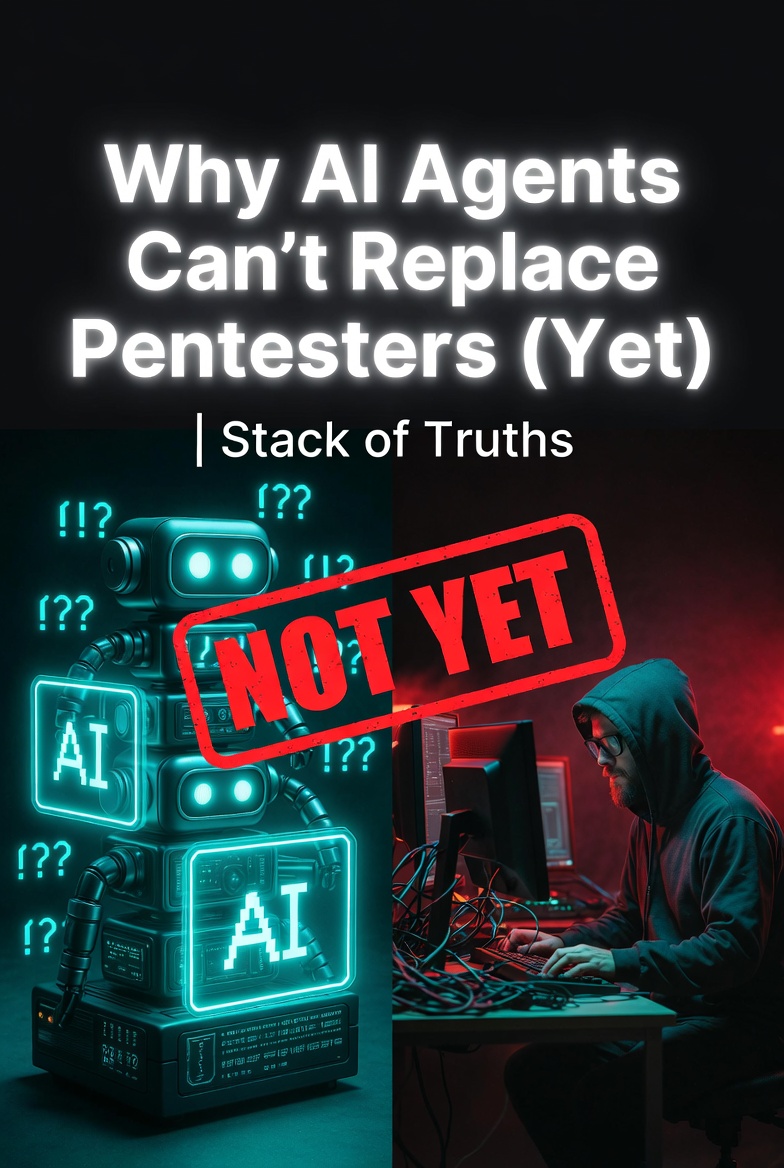
Long answer: AI agents are powerful tools. They can generate test cases, run scans, and draft reports. But they cannot replace a human pentester who thinks like an attacker, verifies findings, and certifies compliance.
AI agents can help you test faster. They cannot help you test better by themselves. The difference between an automated scan and a real pentest is judgment — and judgment is still human.
What AI Agents Can Do
Let me be clear: I use AI agents in my workflow. They’re not useless. They’re just not sufficient.
- Generate test cases — prompt injection templates, attack vectors, edge cases
- Run automated scans — port scanning, dependency checks, known CVEs
- Analyze code patterns — find hardcoded secrets, unsafe functions, known anti-patterns
- Draft report sections — summarize findings, format recommendations
- Suggest remediation steps — based on known fixes for common vulnerabilities
All valuable. All accelerate the pentest process. None replace the pentester.
What AI Agents Cannot Do
| Task | Can AI Do It? | Why Not | \
|---|---|---|
| Find novel business logic flaws | ❌ No | Requires understanding intent, not just patterns |
| Verify false positives | ❌ No | Requires context, judgment, and often manual testing |
| Chain multiple low-risk issues into critical exploit | ❌ No | Requires creative thinking across system boundaries |
| Certify compliance (NIST AI RMF, EU AI Act) | ❌ No | Only a human with legal authority can attest |
| Understand business context | ❌ No | AI doesn’t know what data is actually sensitive to your business |
| Adapt to novel defenses | ❌ No | Attackers adapt. AI patterns. Not the same. |
Real-World Example: The False Positive Problem
I recently tested an AI agent where an automated scanner reported 12 “critical” SQL injection vulnerabilities.
An AI agent would have stopped there. Flagged them all. Called it a day.
I manually tested each one. 11 were false positives. The scanner misidentified parameterized queries as vulnerable because it couldn’t trace the code flow.
The one real vulnerability? A business logic flaw the scanner never even looked for.
This is the difference between automation and expertise.
What NIST AI RMF Says
The NIST AI Risk Management Framework requires independent testing, adversarial testing, and continuous monitoring.
The key word is “independent” — a human who can attest to findings, follow evidence chains, and take responsibility for outcomes.
No framework accepts “an AI agent ran the tests” as certification. And no enterprise buyer will accept it either.
What Your Clients Need to Understand
If you’re selling AI agent pentesting services, your clients need to know:
- AI can help, but cannot replace — your value is human judgment, not just running tools
- Compliance requires human attestation — audits need signatures, not API responses
- Attackers are human-led — AI-assisted humans, not autonomous agents (yet)
- False positives need verification — AI can’t distinguish real from noise
- Business logic is context-dependent — AI doesn’t understand your business
How I Use AI in My Pentest Workflow
I’m not anti-AI. I use it every day. Here’s how:
- Generate initial test cases — prompt injection templates, attack vectors
- Draft report sections — faster delivery, human-reviewed
- Suggest remediation steps — based on known patterns
- Run automated scans — speed, not judgment
But I never trust AI outputs without verification. Every finding is manually reviewed. Every false positive is eliminated. Every business logic flaw is discovered through human reasoning.
AI agents are tools. Powerful tools. But still tools.
They can generate test cases. They cannot think like an attacker.
They can run scans. They cannot verify findings.
They can draft reports. They cannot certify compliance.
The future of pentesting is AI-assisted, not AI-replaced.
If someone promises you an AI-only pentest, ask who’s verifying the results.
Need a pentest that actually finds vulnerabilities?
I use AI to work faster. I use human judgment to work better. Every finding verified. Every false positive eliminated. Every report certified.
📩 DM @StackOfTruths on XFree 15-min consultation. No hard sell. Just honest answers about your AI agent security.















Leave a Reply