
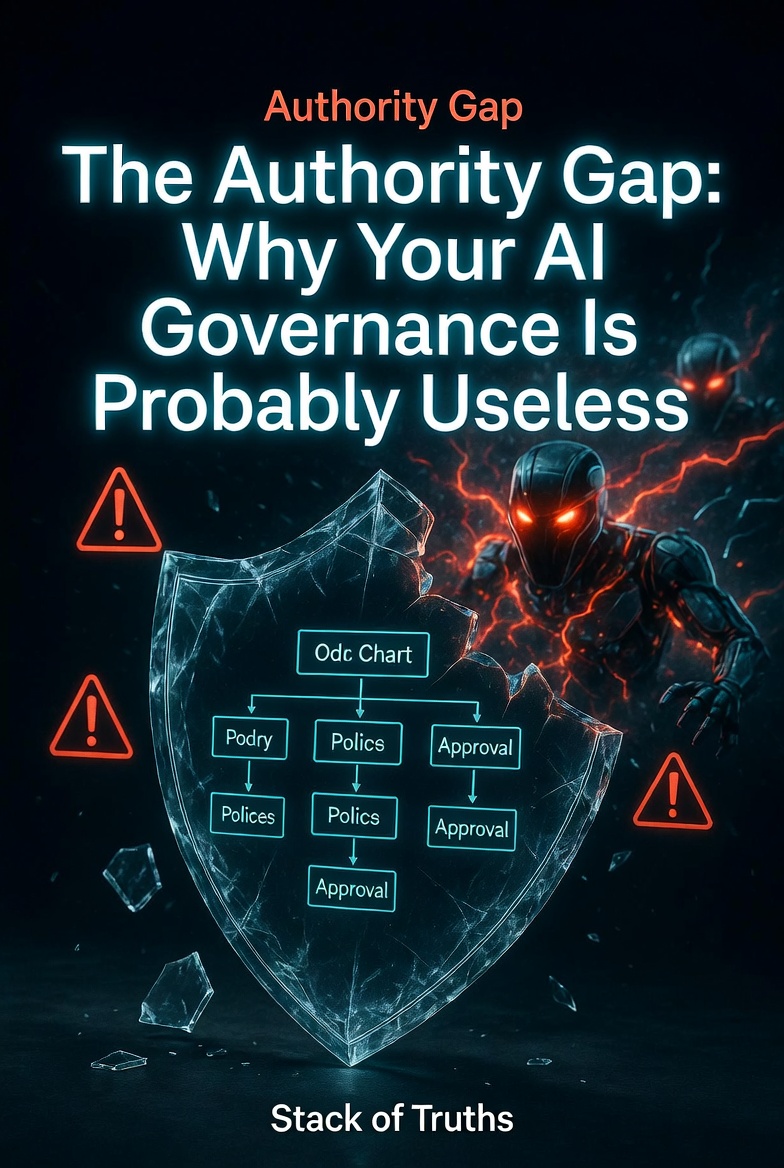
The Authority Gap: Why Your AI Governance Is Probably Useless
Everyone is building layers around AI governance. Governance frameworks. Admissibility checks. Execution engines. Hardware controls.
Individually, they’re all valid. But there’s a critical gap hiding in plain sight that I see repeatedly in my pentesting work:
Where is authority actually resolved?
Most systems describe what should happen. Who owns the decision. What policies apply.
But when a decision is about to bind into reality — to spend money, delete data, access systems — something very different is required.
Not explanation. Not validation. Not policy reference.
Authority.
The Problem: Systems Mark Their Own Homework
When I test AI agents, I look for one thing: can the agent act without proving it has the right to act?
Most systems fail this test immediately.
They assume authority because upstream governance said so. They infer admissibility because “it should work.” They reconstruct evidence after the fact when auditors ask questions.
That’s not governance. That’s exposure.
When authority and execution collapse into the same system, there’s no independent check. The system decides whether it’s allowed to act — and then acts.
That’s not AI governance. That’s AI self-dealing.
What Most AI Governance Does
| What Systems Describe | What They Don’t Resolve | \
|---|---|
| What should happen | Whether it’s allowed to happen right now |
| Who owns the decision | Whether decision-maker still has authority |
| What policies apply | Whether policies have been verified in real time |
| Testing admissibility | Proving right to act before execution |
Everything upstream defines “what should happen.” The execution boundary determines “what is allowed to happen.”
If those collapse into the same system, the check is meaningless.
How I Test This in Real Pentests
When a client asks me to break their AI agent, here’s what I do:
- Authority assumption test: Can the agent act without explicit permission at that moment?
- Authority inheritance test: If Agent A delegates to Agent B, does B verify A had the right to delegate?
- Audit trail test: Are the logs accurate, or were they written after the fact?
- Independence test: Would an independent observer confirm the same authority?
Real-World Example: The Delegation Nightmare
I tested an AI agent that could delegate tasks to other agents. The system verified credentials at the first step. Then it assumed.
Agent A → Authorized. Agent A → Delegates to Agent B. Agent B → Executes.
Question: Did Agent A have the right to delegate?
Answer from the system: “We assumed so.”
That’s not an answer. That’s a breach waiting to happen.
Not “does the agent have permission in theory?”
Not “is there a policy that covers this?”
Not “did someone approve this earlier?”
Does this specific agent, at this specific moment, have the proven right to perform this specific action?
If your system can’t answer that in milliseconds, you don’t have governance. You have liability.
Why This Gap Matters Now
AI agents are no longer suggestions. They’re actors. They spend money. They access data. They delete records. They communicate with customers.
Every action is a binding change to reality.
- One agent with assumed authority can empty your Stripe account
- One delegation chain without verification can expose your entire database
- One “mark your own homework” system can hide an entire breach
The shift that’s coming isn’t more governance layers. It’s this:
Authority must be resolved at execution. Independently. Deterministically. In real time.
What You Should Do Right Now
- Map your agent’s execution boundary — Where does intent become action?
- Check if authority is assumed or verified — Is there an independent check before execution?
- Test delegation chains — Can one agent give authority another agent doesn’t have?
- Audit your audit trail — Would it hold up to an independent investigator?
- Pentest your governance — Not just code. Authority itself.
Once a system can bind to reality without proving its right to act in that moment — you don’t have governance.
You have liability.
The frameworks are necessary. But they’re not sufficient.
What matters is the execution boundary. That’s where authority is resolved. That’s where your security lives or dies.
Does your AI agent assume authority — or prove it?
I break AI agents for a living. Authority gaps are my specialty. Let me test your execution boundary before someone else does.
📩 DM @StackOfTruths on XFree 15-min consultation. No hard sell. Just honest answers about your AI agent security.














Leave a Reply