
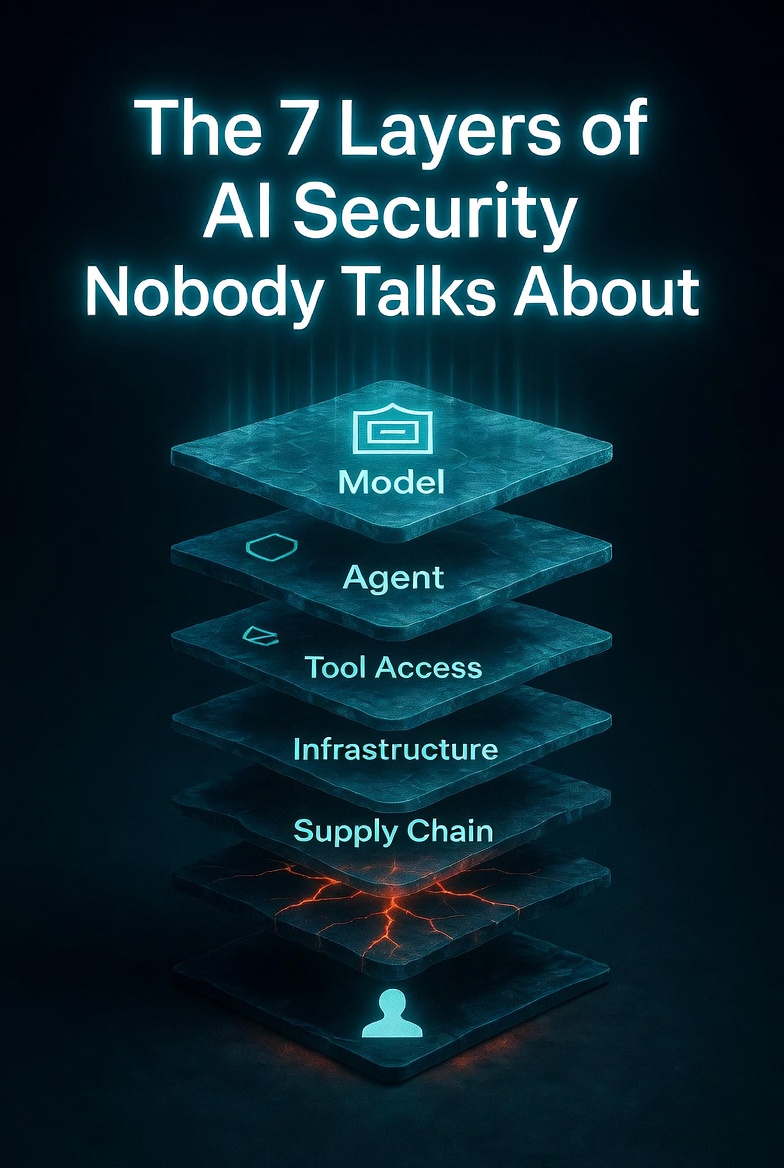
The 7 Layers of AI Security Nobody Talks About
Everyone’s building AI stacks. LLMs here. Vector databases there. Frameworks connecting everything.
It’s beautiful. It’s powerful. It’s also a massive attack surface.
I see founders mapping out their AI ecosystem with pride. And I see attackers mapping out the same thing — looking for the weak spot in every layer.
AI isn’t one tool. It’s an ecosystem. And every layer has vulnerabilities that most builders never consider.
The 7 Layers of AI (And Where They Break)
GPT, Claude, Gemini, Mistral. They understand language and generate ideas. But they’re also gullible.
🔴 Security risks:- Prompt injection — attackers trick your model into ignoring instructions
- Jailbreaks — role-play attacks that bypass safety filters
- System prompt extraction — leaking your secret instructions
- Data leakage — training data extracted through clever queries
LangChain, LlamaIndex, Haystack. They connect models to tools, data, and workflows. They also inherit vulnerabilities.
🔴 Security risks:- MCP design flaws — 150M+ downloads with RCE vulnerabilities
- Tool call abuse — attackers trick your agent into calling malicious tools
- Unsafe deserialization — framework blindly trusts serialized data
- Supply chain attacks — compromised dependencies
Pinecone, Weaviate, Chroma. They store meaning, not just text. They also store everything else.
🔴 Security risks:- Data poisoning — attacker injects malicious content into your knowledge base
- Unauthorized retrieval — no access control at the vector level
- PII leakage — sensitive data stored in vectors, never deleted
- Indirect prompt injection — malicious content retrieved from vectors triggers harmful behavior
FireCrawl, Crawl4AI, Docling. They pull information from messy sources. They also pull in attacks.
🔴 Security risks:- Indirect prompt injection — hidden instructions in webpages your agent reads
- Malicious source documents — PDFs, emails, or websites with embedded attacks
- SSRF via crawler — attacker makes your system fetch malicious URLs
- Data exfiltration — extracted data sent to attacker-controlled endpoints
Hugging Face, Ollama, Groq. They run models locally or in the cloud. They also run with configs you forgot to lock down.
🔴 Security risks:- Exposed endpoints — no authentication on internal APIs
- Misconfigured permissions — anyone can load or unload models
- Model theft — attackers download your fine-tuned models
- Adversarial inputs — crafted inputs that cause model misbehavior
OpenAI, SBERT, Voyage, Cohere. They convert text to vectors. They also can leak what they encoded.
🔴 Security risks:- Reverse engineering — attackers reconstruct sensitive data from vectors
- Membership inference — attackers determine if specific data was in training
- Embedding inversion — extracting original text from vector representations
- Property inference — learning statistical properties of your data
Giskard, Ragas, TruLens. They measure accuracy and reliability. They don’t measure security.
🔴 Security risks:- False sense of security — “it passes evaluation” ≠ “it’s secure”
- No adversarial testing — evaluation doesn’t include attack scenarios
- Blind spots — evaluation misses prompt injection and jailbreak success rates
- Missing red team metrics — you don’t know what you’re not measuring
You built the AI stack. Now let me show you where it breaks.
Every layer has vulnerabilities. Attackers know them. They’re probing your systems right now.
The question isn’t “if” someone will find a weakness. It’s “when” — and “what will they do when they find it?”
What You Should Do Right Now
- Map your AI stack — List every layer. Every tool. Every integration.
- Audit each layer for common vulnerabilities — Use the checklists above.
- Test your LLM for prompt injection and jailbreaks — Simple tests reveal critical flaws.
- Review your framework versions — MCP has known RCE vulnerabilities. Update now.
- Check vector database access controls — Can anyone query anything?
- Validate your data extraction sources — Treat all external content as untrusted.
- Secure your runtimes — No exposed endpoints without auth.
- Add adversarial evaluation — Don’t just measure accuracy. Measure security.
- Get a real pentest — Automated scanners miss what human-led red teaming finds.
Most founders understand the AI stack. Few understand where it breaks.
Attackers do.
Don’t wait for them to show you.
You built the AI stack. Let me test where it breaks.
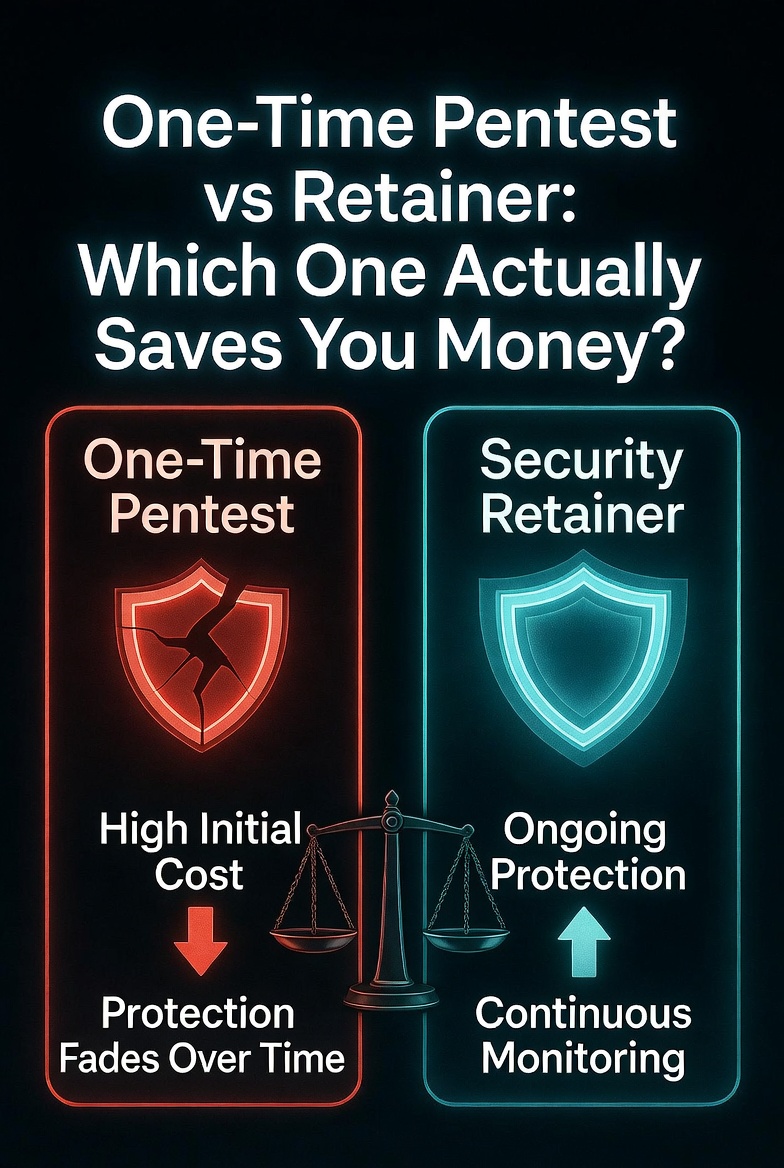
Full AI agent pentest: $3,000. AI Red Team: $5,000. Security retainer: $1,500/month.
📩 DM @StackOfTruths on XFree 15-min consultation. No hard sell. Just honest answers about your AI agent security.



















Leave a Reply