
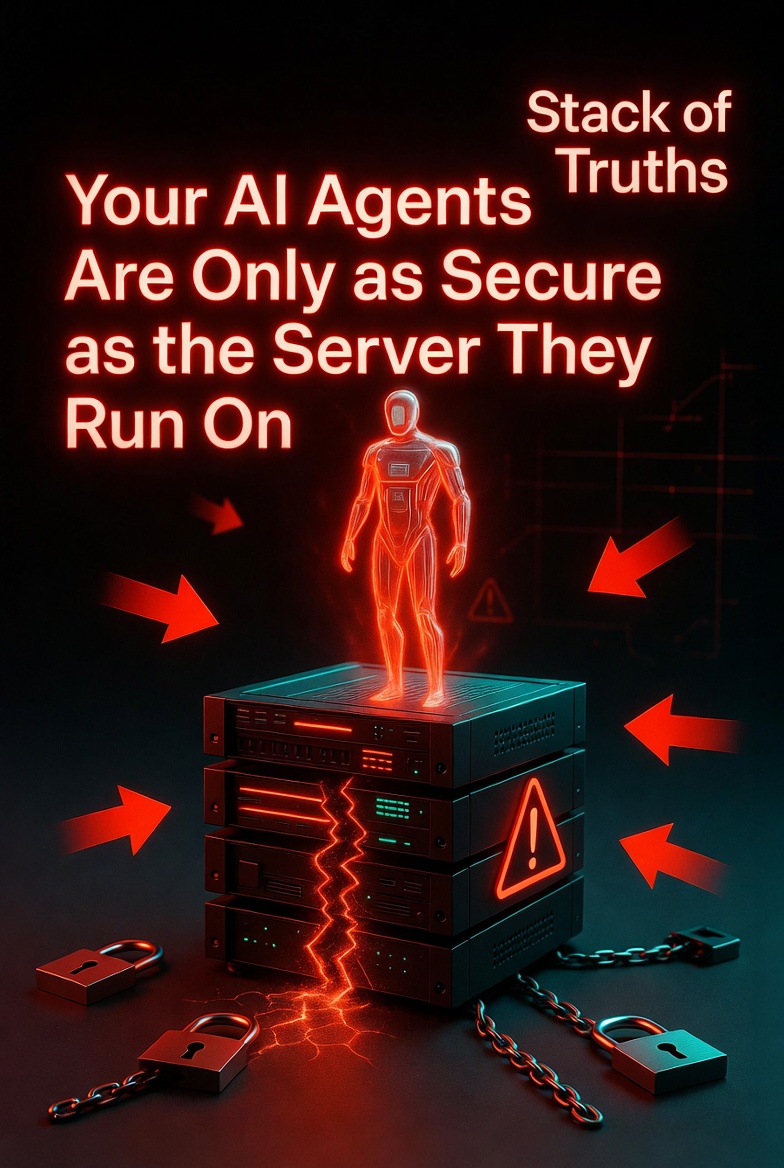
Your AI Agents Are Only as Secure as the Server They Run On
Over the past year, I’ve audited dozens of cloud servers running AI agent infrastructure for clients. The same issues keep appearing.
SSH with root login and password auth. Databases exposed to the internet. Admin tools open to the world. Unidentified HTTP services on random ports. No firewall. Brute force protection disabled. No threat intelligence sharing.
Your AI agents are only as secure as the server they run on. You can have the most sophisticated prompt injection defenses in the world. If an attacker can SSH into your box, none of it matters.
Common Infrastructure Risks
Based on real audits. No advanced scanning needed. Just basic tools available to anyone.
| Risk Category | Why It Matters for AI Agents | Severity | \
|---|---|---|
| SSH misconfiguration root login + password auth enabled |
Attacker gets in → controls your agent infrastructure → poisons models, steals API keys, runs malicious code | CRITICAL |
| Database exposed to internet no firewall, default ports |
Your agents store data here. Chat histories. User inputs. API keys. One leak = everything. | CRITICAL |
| Pentesting/admin tools exposed C2 frameworks, dashboards, dev panels |
Attackers don’t need to hack your agents. They already own the server. | CRITICAL |
| Unidentified HTTP services unknown processes on non-standard ports |
No documentation. No owner. No purpose. Unknown attack surface = unacceptable risk. | CRITICAL |
| No firewall configured every port open to the world |
Your agent APIs, databases, internal tools — all exposed by default | HIGH |
| Fail2ban installed but not active brute force protection disabled |
Automated attacks will eventually succeed. Your agents keep running, serving malicious requests. | HIGH |
| No CrowdSec no global threat intelligence |
Fail2ban blocks known bad IPs locally. CrowdSec shares threat intelligence globally. Without it, you fight alone. | HIGH |
These aren’t sophisticated exploits. These are basic configuration failures. And attackers don’t need zero-days when your SSH door is already open.
Why AI Agents Make This Worse
Traditional servers host static applications. AI agents are different:
- Your agents have API keys — to LLMs, to databases, to payment systems. Those keys live on your server.
- Your agents store chat histories — containing user prompts, personal information, sometimes trade secrets.
- Your agents run code — an attacker who owns your server can make your agents do anything.
- Your agents are trusted — once an attacker is inside, they can use your agents to attack your customers.
What You Should Do Right Now
The Defense Playbook
- SSH hardening — disable root login, disable password auth, use keys only → 90% of automated attacks go away
- Install a firewall — block everything by default, only open what you absolutely need
- Kill unknown services — every running process should be documented and necessary
- Bind admin tools to localhost — use a VPN or Tailscale for access, don’t expose to the internet
- Enable fail2ban — automatic bans on brute force attempts
- Install CrowdSec — global threat intelligence sharing. Attacker hits one server → all servers learn
- Regular audits — scan your own ports monthly. Attackers are. You should be too.
Why CrowdSec Matters
Fail2ban blocks IPs locally. CrowdSec shares intelligence globally.
- Fail2ban: An attacker hits your server → you block them. Same attacker hits 100 other servers → each server fights alone.
- CrowdSec: An attacker hits your server → you block them AND every other CrowdSec server learns to block them instantly.
For AI agent infrastructure, where attackers are automated and scale their attacks, CrowdSec is not optional.
Most AI startups are feature-focused, not security-focused. They don’t know their database is wide open. They don’t know their admin tools are exposed. They don’t know their SSH is configured for disaster.
The breach won’t come from a sophisticated AI prompt injection. It will come from a basic port scan and a default configuration.
Don’t let that be you.
Need a security audit for your AI agent infrastructure?
I break AI agents — and the servers they run on. Infrastructure audit. Agent pentesting. Full-stack security.
📩 DM @StackOfTruths on XFree 15-min consultation. No hard sell. Just honest answers about your AI agent security.














Leave a Reply